Have you ever felt like you just couldn’t catch your breath — even at rest? That sensation, medically known as dyspnea, is one of the most common reasons people visit emergency rooms and primary care physicians worldwide. Whether you’re a patient trying to understand your diagnosis paperwork, a caregiver, or simply someone curious about medical coding, you’ve probably come across the term shortness of breath ICD 10 and wondered what it actually means.
In this guide, we’ll break down:
- What the ICD-10 code for shortness of breath is and how it’s used
- The difference between dyspnea, cough ICD 10 codes, and related conditions
- Common causes and when shortness of breath becomes an emergency
- Practical steps you can take to manage and communicate your symptoms
By the end, you’ll have a clear, confident understanding of how this symptom is classified, diagnosed, and treated — without needing a medical degree to follow along.
What Is ICD-10 and Why Does It Matter?
Before diving into the specific shortness of breath ICD 10 code, it helps to understand what ICD-10 actually is.
ICD-10 stands for the International Classification of Diseases, 10th Revision. It’s a globally standardized system developed by the World Health Organization (WHO) that doctors, hospitals, and insurance companies use to classify and record medical diagnoses and symptoms. Every symptom, disease, and condition has its own unique alphanumeric code.
These codes matter because they:
- Help insurers process claims and determine coverage
- Allow healthcare providers to communicate precisely across facilities
- Enable public health researchers to track disease trends
- Ensure your medical records are accurate and complete
When a physician writes a code on your chart or insurance form, that code tells the entire story of your diagnosis in just a few characters.
Shortness of Breath ICD 10 Code: What Is It?
The primary ICD-10 code for shortness of breath — also called dyspnea — is:
R06.0 — Dyspnea
This falls under the broader category R06 — Abnormalities of breathing, which is grouped within the ICD-10 chapter covering Symptoms, Signs and Abnormal Clinical and Laboratory Findings (Chapter XVIII, codes R00–R99).
Subtypes of Dyspnea ICD 10 Codes
Within the R06.0 category, there are more specific subcodes used depending on the exact nature of the breathing difficulty:
| ICD-10 Code | Description |
|---|---|
| R06.00 | Dyspnea, unspecified |
| R06.01 | Orthopnea (difficulty breathing when lying flat) |
| R06.09 | Other forms of dyspnea |
| R06.1 | Stridor (high-pitched, harsh breathing sound) |
| R06.2 | Wheezing |
| R06.09 | Shortness of breath, not elsewhere classified |
When your doctor documents R06.00, it typically means shortness of breath has been noted as a symptom but a definitive underlying cause hasn’t been confirmed yet — or the dyspnea is the primary complaint being evaluated.
Dyspnea ICD 10 vs. Shortness of Breath ICD 10
Here’s a question many people ask: Is there a difference between dyspnea ICD 10 and shortness of breath ICD 10?
Not really. “Dyspnea” is the clinical term for shortness of breath — they refer to the same experience. In medical documentation, you’ll see both terms used interchangeably, and both map to the R06.0x code range. Your physician may use “dyspnea” in formal records while describing it as “shortness of breath” in conversation with you.
Cough ICD 10: How It Relates to Breathing Difficulty
Coughing and shortness of breath often go hand in hand. The cough ICD 10 code is:
R05 — Cough
More specifically:
- R05.1 — Acute cough
- R05.2 — Subacute cough
- R05.3 — Chronic cough
- R05.4 — Chronic cough syncope
- R05.9 — Cough, unspecified
When a patient presents with both a cough and shortness of breath, a provider may list both ICD-10 codes — for example, R05.9 alongside R06.00 — to create a full picture of the presenting symptoms. This is important for accurate insurance billing and treatment documentation.
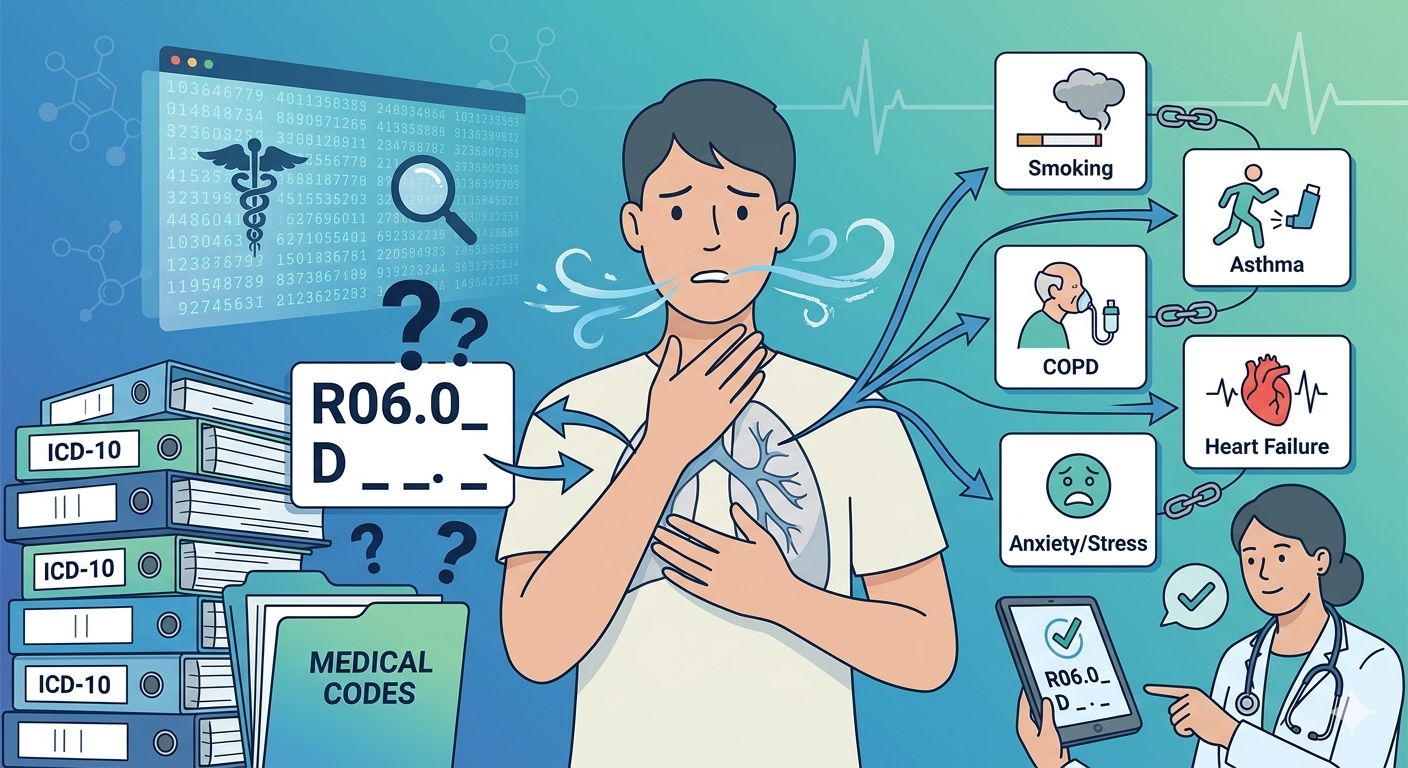
Conditions like asthma, bronchitis, pneumonia, and COPD commonly produce both symptoms together, and identifying them separately through coding helps healthcare teams track patterns and outcomes more accurately.
Common Causes of Shortness of Breath
Dyspnea can stem from a wide range of conditions — some mild and easily treated, others requiring urgent medical attention. Understanding these causes can help you communicate more effectively with your doctor.
Respiratory Causes
- Asthma — Airway inflammation causes narrowing and breathlessness, especially triggered by allergens, exercise, or cold air
- Chronic Obstructive Pulmonary Disease (COPD) — A progressive lung condition often linked to smoking
- Pneumonia — Lung infection that fills air sacs with fluid
- Pulmonary embolism — A blood clot in the lungs, a medical emergency
- COVID-19 and post-COVID syndrome — Shortness of breath remains one of the most reported symptoms
Cardiac Causes
- Heart failure — The heart’s inability to pump blood efficiently causes fluid buildup in the lungs
- Arrhythmia — Irregular heartbeat can reduce the efficiency of oxygen delivery
- Coronary artery disease — Reduced blood flow to the heart can manifest as breathlessness during exertion
Other Causes
- Anemia — Low red blood cell count reduces oxygen transport
- Anxiety and panic attacks — Can produce very real, intense shortness of breath
- Obesity — Excess weight puts mechanical strain on the respiratory system
- High altitude — Lower oxygen levels in the air cause dyspnea in some individuals
- Pregnancy — The growing uterus puts pressure on the diaphragm
When Is Shortness of Breath a Medical Emergency?
Not all episodes of dyspnea are equal. Some are mild and resolve with rest; others are life-threatening and require immediate care.
Seek Emergency Care Immediately If You Experience:
- Sudden, severe shortness of breath with no clear cause
- Chest pain or pressure alongside breathing difficulty
- Coughing up blood or pink-tinged mucus
- Blue or gray lips, fingertips, or face (cyanosis)
- Confusion, dizziness, or loss of consciousness
- Rapid heartbeat combined with breathing difficulty
These symptoms could indicate a pulmonary embolism, heart attack, severe asthma attack, or anaphylaxis — all of which are medical emergencies requiring 911 or immediate hospital care.
Non-Emergency But Promptly Evaluate:
- Shortness of breath that is new or worsening
- Breathlessness that disrupts your sleep (orthopnea — coded as R06.01)
- Difficulty breathing after minimal exertion
- Shortness of breath accompanied by unexplained weight gain or swelling in the legs
How Doctors Diagnose and Document Dyspnea
When you visit a doctor with shortness of breath, the path from symptom to diagnosis involves several steps — and ICD-10 coding evolves along the way.
Step 1: Initial Symptom Coding
At first, your doctor may only record the symptom — R06.00 (Dyspnea, unspecified) — while ordering tests.
Step 2: Diagnostic Workup
Common tests include:
- Pulse oximetry — Measures blood oxygen levels
- Chest X-ray — Looks for fluid, infection, or structural problems
- Spirometry / Pulmonary function tests — Assesses lung capacity
- Electrocardiogram (ECG) — Checks heart rhythm
- Blood tests — Rules out anemia, infection, or blood clots (D-dimer)
- CT pulmonary angiography — Checks for pulmonary embolism
Step 3: Updating the Diagnosis Code
Once a cause is identified, the physician typically replaces the symptom code (R06.00) with the underlying condition’s specific ICD-10 code — for example:
- J45.x for asthma
- J44.x for COPD
- I50.x for heart failure
- I26.x for pulmonary embolism
This progression from symptom code to diagnosis code is standard medical coding practice and ensures that billing and records accurately reflect the care provided.
Living With Dyspnea: Management Tips and Lifestyle Adjustments
If you’ve been diagnosed with a condition causing chronic shortness of breath, day-to-day management is key to maintaining quality of life.
Breathing Techniques That Help
- Pursed lip breathing — Breathe in through your nose, then slowly exhale through pursed lips (like you’re blowing out a candle). This slows breathing and improves oxygen exchange.
- Diaphragmatic breathing — Focuses on belly breathing rather than chest breathing, reducing breathing effort.
- Positioning — Sitting upright or leaning forward slightly can ease breathlessness for many people.
Lifestyle Changes That Make a Difference
- Quit smoking — The single most effective step for COPD and many lung conditions
- Maintain a healthy weight — Reduces mechanical load on the respiratory system
- Stay active within your limits — Pulmonary or cardiac rehabilitation programs build endurance over time
- Manage triggers — Allergens, air pollution, extreme temperatures, and stress are common dyspnea triggers
- Monitor your oxygen levels at home — A pulse oximeter (available at most pharmacies) can alert you to drops in oxygen saturation
Medications Commonly Used
Your doctor may prescribe:
- Bronchodilators or inhalers (for asthma or COPD)
- Diuretics (to reduce fluid in heart failure)
- Anticoagulants (for blood clots)
- Iron supplements or transfusions (for anemia-related dyspnea)
Always follow your physician’s guidance and never adjust medications without consultation.
FAQ: Shortness of Breath ICD 10 — Common Questions Answered
Q1: What is the exact ICD-10 code for shortness of breath?
The primary ICD-10 code for shortness of breath is R06.00 (Dyspnea, unspecified). More specific subtypes include R06.01 for orthopnea (difficulty breathing when lying down) and R06.09 for other specified forms of dyspnea. Physicians select the most accurate subcode based on the patient’s specific presentation.
Q2: Is dyspnea ICD 10 the same as shortness of breath ICD 10?
Yes. Dyspnea is the clinical term for shortness of breath, and both map to the same ICD-10 code range (R06.0x). You may see either term in your medical records — they describe the same symptom.
Q3: What is the cough ICD 10 code, and when is it used alongside shortness of breath?
The ICD-10 code for cough is R05. When a patient presents with both coughing and shortness of breath — as in asthma, pneumonia, or bronchitis — both R05 and R06.00 may be listed together in the medical record to fully document the symptom picture.
Q4: Can shortness of breath be coded as a primary diagnosis?
Yes. When no underlying cause has been identified — or when dyspnea is the primary presenting complaint in an emergency — R06.00 can serve as the primary diagnosis code. Once a definitive diagnosis is established, a more specific ICD-10 code for the underlying condition typically takes over.
Q5: When should I go to the ER for shortness of breath?
Seek emergency care immediately if shortness of breath is sudden and severe, accompanied by chest pain, or if your lips or fingernails are turning blue. Also go to the ER if you’re confused, dizzy, or your breathing is rapidly getting worse. These may signal life-threatening emergencies like a pulmonary embolism or heart attack.
Conclusion: Understanding Your Diagnosis Empowers You
Navigating medical coding, diagnoses, and insurance paperwork can feel overwhelming — especially when you’re already dealing with the discomfort of breathing difficulties. But knowing what shortness of breath ICD 10 (R06.00) means, how it relates to dyspnea ICD 10 and cough ICD 10 (R05) codes, and what steps come next puts you firmly in the driver’s seat of your own healthcare journey.