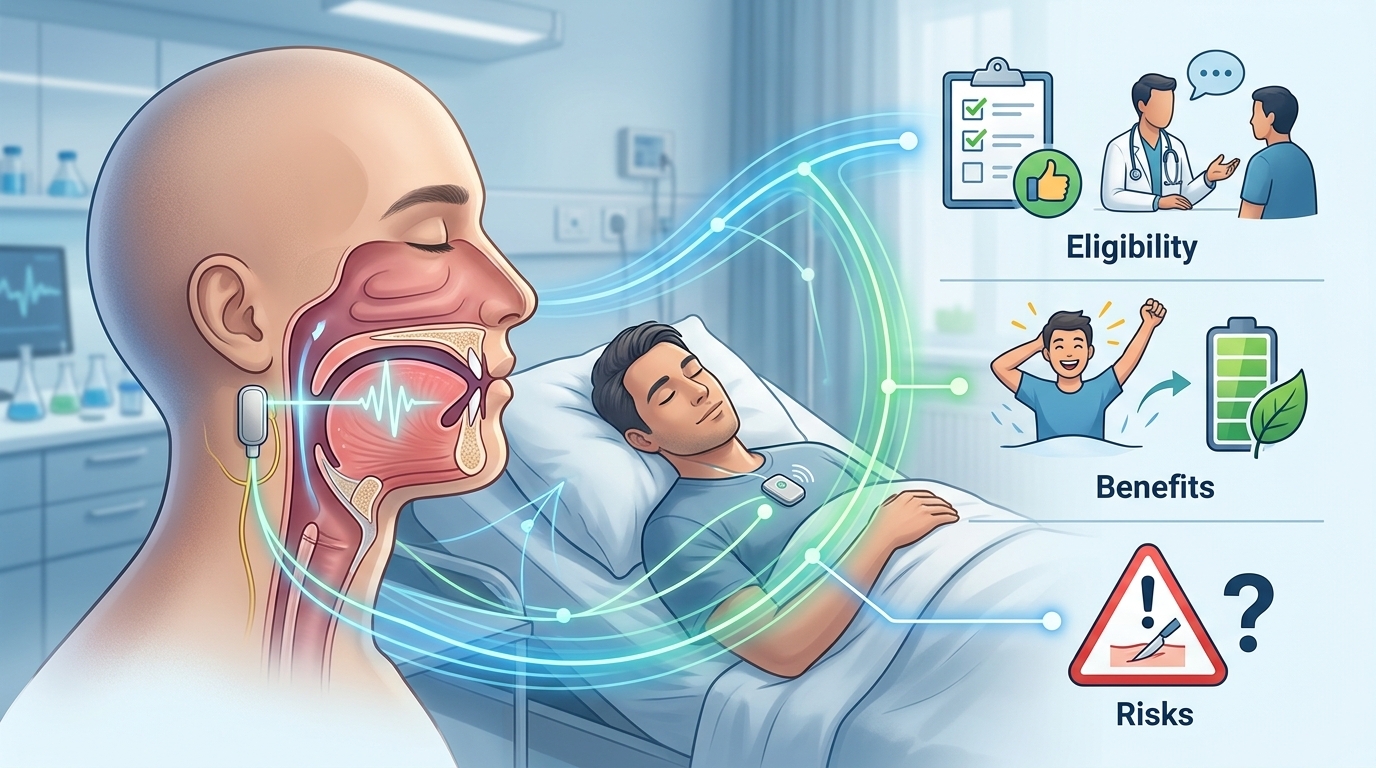
A sleep apnea implant is a device implanted surgically to keep the airway from closing during sleep. Pillar procedure is usually recommended for people with moderate to severe obstructive sleep apnea who would either prefer not to use or are unable to benefit from continuous positive airway pressure therapy.
Of these, the most well-known alternative is Inspire upper airway stimulation. It delivers low-level electric signals to the hypoglossal nerve and controls the motion of your tongue. It keep the tongue moving forward to avoid it falling back and blocking the throat which can cause snoring during sleep. Not all know that implant therapy is not for everybody. Your sleep study, airway anatomy, health history, and past treatment results have to be reviewed by both a sleep specialist and an ear, nose & throat surgeon.
What Is the Implant for Sleep Apnea?
The implant for obstructive sleep apnea is called a hypoglossal nerve stimulation system or upper airway stimulation system.
There are three key implanted components of the Inspire system:
Probably a compact pulse generator with the battery and electronics
A breathing sensor that listens for when you breathe in
A stimulation lead bound with the hypoglossal nerve
There is an external remote as well. Before bedtime, the patient employs the remote to activate therapy; upon awakening, he or she switches it off. One doctor programs stimulation level according to patient needs. Not treating obstructive sleep apnea (OSA), or OSA, It involves the relaxation of tissue in the throat, which blocks airflow when you sleep — a phenomenon that is known as obstructive (OSA).
It is usually not used to treat central sleep apnea, which occurs when the brain forgets to send the needed signals to breathe. The FDA says Inspire is not to be used when central and mixed apneas comprise more than 25% of a patient’s total apnea-hypopnea index. How does the Sleep Apnea Implant Work?
It employs the method of his natural breath.
Here is the basic process:
The patient uses an included remote to switch on the device before bedtime.
After a short while, sufficient time will have elapsed for the patient to fall asleep.
The breathing sensor recognizes every breath that I take.
The pulse generator transmits an regulated electric current.
This signal then stimulates the hypoglossal nerve.
The tongue and muscles around the airway move anterior.
The airway stays more open with the patient breathing.
The electrical impulses are synchronized with inhalation. They do not pump air into the lungs. Vocal cords, for example; instead of vibrating normally, they tense up in order to keep the tongue from falling back into your throat and blocking it. ulation level can be adjusted. Some patients require many follow up visits and a sleep study to determine settings that provide adequate treatment without causing excessive discomfort.
How Does Inspire Sleep Work?
It is sometimes referred to as a “pacemaker for the airway” or Inspire therapy. This comparison is helpful, although those systems are doing different kinds of work.
Essentially, heart pacemaker controls or support heart rhythm. Inspire then stimulates the nerve that controls tongue movement, which keeps you breathing regularly all night long.
The therapy is guided by the patient itself. The remote can be used to:
Turn treatment on and off
Pause stimulation during the night
Modify the powerinside thresholds based upon the doctor
A treatment that only works when you turn it on. Thus, this requires the patient to turn it on before sleeping.
Inspire does not permanently change the anatomy of the throat or jaw. It does this by stimulating the muscles that close off the upper airway.
CPAP Implant: Is It the Same as CPAP?
People sometimes use the term “CPAP implant,” but this is not medically accurate.
CPAP and implant therapy work in different ways.
| CPAP therapy | Implant therapy |
|---|---|
| Uses a bedside machine | Uses a surgically placed device |
| Delivers pressurized air | Stimulates the hypoglossal nerve |
| Requires a mask and hose | Does not require a mask or hose |
| Does not require surgery | Requires surgery and recovery |
| Can be adjusted without an operation | May require programming and future procedures |
| Suitable for many OSA patients | Suitable only for selected patients |
CPAP remains a standard and highly effective treatment when it is used consistently. Implant therapy is normally considered when CPAP or another positive airway pressure treatment has failed, cannot be tolerated, or is not medically suitable. Surgery is generally considered after less invasive options have been assessed. t should not stop using CPAP simply because implant treatment is available. Treatment changes should be made with a sleep specialist.
Who May Qualify for an Implant for Sleep Apnea?
Indication varies according to device type, patient anatomy, FDA labeling and insurance.
The expanded FDA indication allows Inspire to be used in adults 22 years and older who:
Suffer from moderate to severe obstructive sleep apnea
You have an AHI of 15 to 100 events per hour
Not able to use or tolerate PAP or BiPAP treatment
DO NOT HAVE FULL CONCENTRIC COLLAPSE AT SOFT PALATE
In 2023, the FDA raised its maximum BMI recommendation for treatment to 40. Insurance policies, though, may have more limited definitions. For example, some of the criteria for Medicare coverage, require a BMI under 35 and an AHI of 15-65. Younger patients may also be eligible under different FDA indications, like some adolescents with Down syndrome and severe OSA. These cases require specialist assessment. s Used to Check Eligibility
A specialist may recommend:
A current overnight sleep study
A review of previous CPAP use
A physical examination
A meta analysis of body mass index and health status
Drug-induced sleep endoscopy
Central and mixed apnea events were assessed
Drug-induced sleep endoscopy also involves the patient undergoing sedation while a doctor inspects how the airway is collapsing. Complete concentric collapse at the soft palate make Inspire inappropriate. May Not Be a Good Candidate?
Who is this treatment not suitable for?
Mainly have complex or central sleep apnoea
Have an airway structure that prevents stimulation from acting
A3. Not able to operate the remote itself without help
Are pregnant or planning pregnancy
Have certain neurological conditions
They have a second implanted device that could cause interference between systems, for example
Requiring MRI scans prohibited by their device-specific MR conditions
MRI compatibility relies on the specific model and manufacturers’ recommendations. Patients must always communicate to imaging staff that they have an implanted stimulation system. Procedure: Apnea Surgery Implant Self-Introduction
A trained surgeon carries out the implantation, typically under general anesthesia.
The stimulation lead is placed lateral to the hypoglossal nerve They are implanted simply under the skin – the breathing sensor and pulse generator. Incision sites and device design might differ a little.
It is not always turned on after the surgery. The surgical area needs to heal first. On a subsequent visit, the system is activated by the medical team, who educates the patient on using the remote and starts programming stimulation.
Follow-up sleep studies for adjustment of treatment are sometimes done.
Recovery After Surgery
Patients may experience temporary:
Pain around the incisions
Swelling
Soreness
Nausea
Headaches
Tongue weakness
Difficulty speaking or swallowing
Recovery looks different for everyone. Wound care, physical activity levels, medications, sleeping position, and follow up appointments are all required to be followed according to what the surgeon recommended.
Inspire Sleep Apnea Implant: Benefits and Limitations
And the best part is that it treats from the inside out without a mask or hose to wear at night.
Potential benefits include:
Fewer obstructive breathing events
Reduced snoring
Better sleep quality
Less daytime sleepiness
Improved daily functioning
Increased treatment use in some CPAP-intolerant patients
Approximately 66% of subjects in the original STAR clinical study achieved either a sustained AHI response or other significant outcomes after 12 months. Patients with favourable characteristics sequenced improvement scores over 5 years during longitudinal follow-up. However, the original study involved a select group of participants, so results should not be assumed to apply to every patient. ystematic review also demonstrated persistent improvements in OSA control and quality-of-life measures in clinical or real-world evidence. rtant Limitations
This treatment:
Does not work for everyone
Requires an operation
Requires nightly activation
Needs medical programming and follow-up
May not stop all of apnea events
May not eliminate other forms of treatment
May need another operation to fix, replace or remove
May have insurance restrictions
For patients the criteria for success is not simply whether snoring becomes quieter (as per their subjective sense) but rather by follow-up sleep testing, reduction in symptoms as well as club review.
Possible Risks and Side Effects
All surgery carries risk. Possible procedure-related problems include:
Pain
Swelling
Bleeding
Infection
Scarring
Temporary tongue weakness
Nerve injury
Problems with the implanted components
Once the medicine is started there can be side effects like:
Uncomfortable stimulation
Tongue soreness or abrasion
Dry mouth
Changes in tongue movement
Difficulty speaking or swallowing
Discomfort from feeling the device
Sleep disturbance throughout the transitional phase
Most of the issues reported can be significant on their own, but in many cases with healing or medication or by changing settings on stimulation these things improve. But, some complications can be taken care of with further treatment or another surgery. It might also not be enough improvement for an individual patient. Order CPAP in Sleep Apnea: Are There some other implants?
Inspire is not now the only FDA-approved implanted nerve stimulation system for OSA in America.
The FDA approved the Genio System 2.1 on Aug 8, 2025. This is indicated for selected adults 22 years and older with moderate to severe OSA (AHI between 15 and 65). Candidates include patients who have failed, are intolerant of and/or are not candidates for all standard treatments including PAP, oral appliances, lifestyle changes and appropriate medication. It is an implanted stimulator with external parts (wearable patch, charging equipment). It functions and is designed in a different fashion than Inspire.
Just because a device is newer doesn’t mean it’s better. The correct choice depends on:
Airway anatomy
OSA severity
Previous treatment results
Medical conditions
Device availability
Surgeon experience
Insurance coverage
Long-term follow-up requirements
Patients should check with a sleep medicine team qualified in the indications of FDA approval, clinical evidence supporting alternative treatment options, any related risks and how practical daily use would be.
Is Implant Therapy Better Than Other OSA Treatments?
The key point is, there isn’t a one size fits all when it comes to treatment.
Treatment may include:
CPAP or BiPAP
Weight management
Positional therapy
A custom oral appliance
Treatment for nasal obstruction
Tonsil or airway surgery
Jaw advancement surgery
Approved medication for eligible patients
Hypoglossal nerve stimulation
CPAP is non-invasive, works for many clear patients; Oral devices can be used for particular humans with slight or average OSA. Weight Management In people with overweight or obesity, OSA severity decreases if body weight is reduced.
It is most applicable to a patient, however, who has clinically important OSA, tried appropriate standard care, and already meets strict anatomical and medical criteria for being a candidate for the implant.
Frequently Asked Questions
Is an implant a cure for sleep apnea?
No. Long-term therapy for the control of obstructive breathing events. Patients may still have residual apnea and require additional treatment.
Can the implant replace CPAP?
It can potentially replace CPAP in chosen patients who cannot tolerate or benefit from positive airway pressure. We are not replacing every single person with it automatically.
Does the device work for central sleep apnea?
Inspire is intended for obstructive sleep apnea. It should not be used when central and mixed apneas account for more than 25% of the total AHI. you feel the stimulation?
Most patients can feel some tongue or airway movement when the device is active. The stimulation should be strong enough to open the airway but comfortable enough to allow sleep.
Does it stop snoring completely?
It may reduce snoring, but results vary. The main purpose is to treat obstructive breathing events, not merely the sound of snoring.
Can you turn the device off?
Yes. The patient remote is used to turn treatment on before sleep and off after waking. It can also pause therapy temporarily. you have an MRI with the device?
Some models allow certain MRI examinations under specific conditions. Others have greater restrictions. The patient and imaging team must follow the exact manufacturer instructions for the implanted model. insurance cover the procedure?
Many insurance plans consider coverage when medical and eligibility requirements are met. Approval rules differ by insurer and may be narrower than the FDA indication. Prior authorization and proof of CPAP intolerance are often required.
Final Thoughts
A sleep apnea implant can provide meaningful relief for carefully selected people with moderate to severe obstructive sleep apnea who cannot use CPAP successfully. It works by stimulating the nerve that controls tongue movement, helping prevent the airway from closing during sleep.
Still, it is surgery—not a quick fix. Results depend heavily on correct diagnosis, airway anatomy, patient selection, expert implantation, device programming, and long-term follow-up.
Before choosing implant therapy, meet with a board-certified sleep specialist and an experienced ear, nose, and throat surgeon. Ask about your AHI, type of airway collapse, alternative treatments, expected results, surgical risks, insurance requirements, and the evidence supporting each available device.