If you’ve ever typed “how many calories should I eat a day” into Google at 11pm standing in front of an open fridge, you’re not alone — and you’re not going to get a single magic number, no matter how many calculators you plug your stats into. What you can get is a solid, evidence-based range, a way to sanity-check it against your own body, and an understanding of the handful of things (medication, age, training) that push that number around more than most articles admit.
Quick Answer: How Many Calories Should I Eat a Day?
Most adult women need somewhere between 1,600 and 2,400 calories a day, and most adult men need between 2,200 and 3,000, depending on age, size, and how active you are. That’s your starting point, not your prescription. Keep reading and we’ll get you to a number that’s actually yours — whether your goal is weight loss, maintenance, or building muscle.
[Calculator widget placement — embed here]
What the New 2025–2030 Dietary Guidelines Say
Here’s something most calorie articles online haven’t caught up on yet: the numbers you’ll find floating around are usually still pulled from the 2020–2025 Dietary Guidelines for Americans. Those expired. The USDA and HHS released the new 2025–2030 Dietary Guidelines for Americans on January 7, 2026, and the tone shifted noticeably — the whole document is built around a simple message: eat real food.
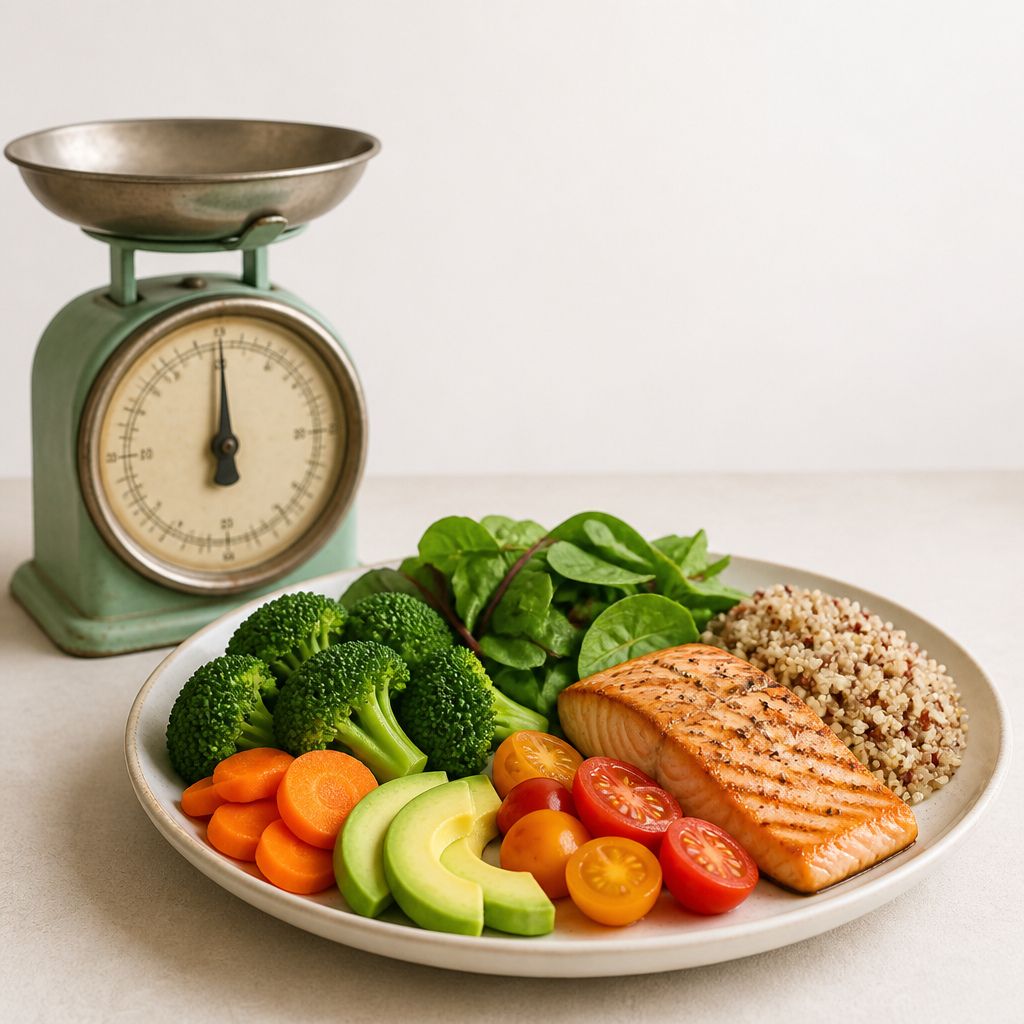
Practically, that means less emphasis on hitting a precise calorie target and more emphasis on where those calories come from — prioritizing protein, healthy fats, fruits, vegetables, and whole grains while cutting back on highly processed foods, added sugar, and excess sodium. The calorie ranges themselves (which we’ll get into next) are similar to before, but the framing around them has changed: it’s not just “eat this many calories,” it’s “eat this many calories of foods that actually do something for you.”
How Many Calories Should You Eat a Day by Age?
If you’re wondering how many calories you should eat a day by age, here’s where the current guidelines land. These are population averages pulled from federal guidance — think of them as a reasonable starting range, not a verdict on what your body specifically needs. If you’re not sure where your weight currently sits relative to a healthy range, a BMI calculator is a quick starting reference point before you dig into calorie targets.
Women
| Age | Sedentary | Moderately Active | Active |
|---|---|---|---|
| 19–30 | 1,800–2,000 | 2,000–2,200 | 2,400 |
| 31–50 | 1,800 | 2,000 | 2,200 |
| 51+ | 1,600 | 1,800 | 2,000–2,200 |
Men
| Age | Sedentary | Moderately Active | Active |
|---|---|---|---|
| 19–30 | 2,400 | 2,600–2,800 | 3,000 |
| 31–50 | 2,200–2,400 | 2,400–2,600 | 2,800–3,000 |
| 51+ | 2,000–2,200 | 2,200–2,400 | 2,400–2,600 |
A quick example of how much activity level alone can swing this: a 35-year-old woman who sits at a desk all day and does no structured exercise is looking at roughly 1,800 calories to maintain her weight. Her identical twin who walks 8,000 steps a day and lifts weights three times a week might need 2,200 — a 400-calorie gap based purely on movement, with nothing else different.
One thing worth flagging clearly: these tables are population averages. Two people of the same age, sex, and activity level can still have genuinely different needs because of height, muscle mass, genetics, and metabolic health. Use the range as a starting point, then adjust based on what actually happens to your weight over the following few weeks — more on that below.
BMR vs. TDEE vs. NEAT — What Actually Determines Your Number
This is the part most articles gloss over, and it’s honestly the part that makes the rest of this make sense.
Your total daily energy expenditure (TDEE) — the number you actually need to maintain your weight — is made up of four pieces:
- BMR (Basal Metabolic Rate): the calories your body burns just existing — keeping your heart beating, your lungs breathing, your organs functioning — if you did nothing but lie in bed all day. This is the biggest chunk, usually 60–70% of your total.
- TEF (Thermic Effect of Food): the energy your body spends digesting and processing what you eat. Protein actually costs more to digest than fat or carbs, which is part of why high-protein diets tend to nudge total calorie burn up slightly. (More on how much protein you need below.)
- NEAT (Non-Exercise Activity Thermogenesis): all the movement that isn’t “exercise” — fidgeting, walking to your car, doing dishes, taking the stairs. This varies wildly between people and is a big reason two people with the same BMR can have very different total needs.
- EAT (Exercise Activity Thermogenesis): calories burned during actual structured workouts.
Here’s why this matters in practice: someone with a desk job who paces during phone calls, takes the stairs, and stands up every hour can burn a genuinely meaningful amount more through NEAT than someone with the identical BMR who sits still all day — even before either of them steps into a gym. That’s the piece a static age-and-sex table can never capture, and it’s a big part of why two people who look similar on paper can eat noticeably different amounts and maintain the same weight.
Which Formula Should You Trust? (Mifflin-St. Jeor vs. Harris-Benedict vs. Katch-McArdle)
Most online calculators use one of three formulas to estimate your BMR, and they’re not interchangeable.
Mifflin-St. Jeor is the current gold standard for most people and what most modern calculators default to. It uses weight, height, age, and sex, and it’s been shown to be more accurate than the older Harris-Benedict equation for the general population.
Harris-Benedict is the original 1919 formula, revised in 1984. It’s still floating around in a lot of older calculators, but it tends to overestimate calorie needs slightly compared to Mifflin-St. Jeor, especially for people who are overweight.
Katch-McArdle is the one to reach for if you actually know your body fat percentage (from a DEXA scan, calipers, or a reasonably accurate smart scale). It calculates BMR based on lean body mass instead of total weight, which makes it notably more accurate for muscular or leaner individuals — a bodybuilder and a sedentary person at the same total weight can have very different BMRs, and this formula is the one that actually captures that difference. Lean mass and protein intake go hand in hand here, which is why this formula tends to matter most for people focused on building or preserving muscle.
If you don’t know your body fat percentage, default to Mifflin-St. Jeor. It’s the most broadly reliable option without extra data.
How to Find Your Number Without a Calculator (The 2-Week Method)
Formulas are estimates, and they’re commonly off by 10–20% in either direction depending on your individual metabolism. So if you want a number you can actually trust, here’s the low-tech version that beats any calculator:
- Track everything you eat for 14 days, as accurately as you reasonably can.
- Weigh yourself under the same conditions each morning (same time, same state of dress, ideally after using the bathroom and before eating).
- Average your weight for week 1 and week 2 separately.
- If your average weight barely moved, your average daily intake over those two weeks is close to your actual maintenance calories — not the number a calculator guessed, but the number your body demonstrated.
- If your weight moved up or down consistently, you now know which direction to adjust from.
This works because it sidesteps every assumption a formula has to make about your metabolism, your NEAT, your hormones — it just measures what actually happened. It takes two weeks instead of two minutes, but it’s the closest thing to a real answer you’re going to get without a metabolic chamber. If you want a middle ground between white-knuckle tracking and total guesswork, this piece on tracking calories without obsessing over them is a good next read.
Calories for Weight Loss, Maintenance, and Muscle Gain
How many calories should you eat a day to lose weight?
A calorie deficit of roughly 500 calories a day below maintenance tends to produce about 1 pound of weight loss per week, since a pound of fat is roughly 3,500 calories. Going much lower than that — especially dropping under 1,200 calories a day for most adults — tends to backfire. You risk nutrient deficiencies, and your body responds to prolonged severe restriction by slowing its metabolic rate to conserve energy, which is exactly the opposite of what you’re trying to do.
Maintenance after a diet
This is the part almost nobody covers, and it’s where a lot of people go wrong. If you’ve been in a calorie deficit for weeks or months, your metabolism has likely adapted downward somewhat — a phenomenon called adaptive thermogenesis, where your body becomes slightly more efficient and burns a bit less than a same-sized person who never dieted. Jumping straight back to your pre-diet “maintenance” number can cause faster regain than expected. A more reliable approach is increasing calories gradually over several weeks — a strategy called reverse dieting — giving your metabolism room to catch back up rather than shocking it with a sudden 500-calorie jump.
How many calories should you eat a day to gain muscle?
You don’t need to eat everything in sight. A modest surplus of 300–500 calories a day, combined with adequate protein intake (roughly 0.7–1 gram per pound of body weight) and resistance training, is enough to build muscle without piling on excess fat. Eating in a huge surplus “to be safe” mostly just adds fat, not muscle — your body can only build lean tissue so fast regardless of how much extra fuel you give it.
Special Situations Most Articles Skip
If You’re on a GLP-1 Medication (Ozempic, Zepbound, Wegovy, etc.)
GLP-1 medications and nutrition deserve their own conversation, because these drugs suppress appetite significantly — your natural intake often drops well below what a standard calculator would recommend, and that’s usually fine, since appetite suppression is the point. What matters more here is protein. Because these medications lead to rapid weight loss, a meaningful portion of that loss can come from muscle if protein intake is too low. Prioritizing protein at each smaller meal — aiming for roughly 25–30 grams per meal where possible — helps preserve lean mass while the medication does the heavy lifting on appetite.
If You’re 65 or Older
The usual framing is “you need fewer calories as you age,” which is true but incomplete — and taken alone, it can lead to eating in a way that accelerates a real problem: sarcopenia, the age-related loss of muscle mass. The more useful frame is protein needs for older adults: even as total calorie needs decline slightly, protein needs don’t decline the same way — many older adults actually need more protein per pound of body weight than they did at 30, not less, to maintain muscle and strength. Simply eating less across the board without protecting protein intake is how “eating less” turns into “losing muscle.”
If You’re Pregnant or Breastfeeding
General guidance suggests an extra 300 calories a day during the second and third trimesters of pregnancy, and roughly 450–500 extra calories a day while exclusively breastfeeding. These are population averages, and pregnancy nutrition has enough individual variation (multiples, pre-pregnancy weight, activity level) that this is genuinely a conversation to have with your OB or a registered dietitian rather than a calculator.
If You’re an Athlete or Training Seriously
The standard “sedentary / moderately active / active” tiers weren’t built with structured training volume in mind. Someone doing two-a-day practices or marathon training blocks can have calorie needs well above the “active” tier in a standard table — sometimes by 500–1,000 calories or more, depending on training load. If you’re training seriously, your number is tied more closely to your actual training volume than to a generic activity label.
Does Calorie Counting Actually Work? (Pros, Limits, and Label Accuracy)
Calorie counting can be a genuinely useful tool for a lot of people — it builds awareness, it makes portion creep visible, and it gives you real data instead of guesses. But it comes with two honest caveats.
First, it’s less precise than it feels. Nutrition labels are legally allowed a fair amount of wiggle room, and calorie counts on packaged food can be off by up to 20% from what’s actually in the package. That means two people diligently logging “the same” 1,800 calories a day could be eating meaningfully different amounts of actual energy. This isn’t a reason to abandon tracking — it’s a reason not to treat the number on your app as gospel down to the calorie.
Second, and more importantly: calorie counting isn’t the right tool for everyone. If you have a history of disordered eating, tracking can reinforce unhealthy patterns rather than support a healthy relationship with food, and it’s worth working with a professional on an approach that doesn’t center on numbers at all.
Also worth remembering: 100 calories of almonds and 100 calories of gummy candy hit your body very differently — in satiety, in nutrients, in blood sugar response. A calorie target is a useful frame, but food quality still does real work that a number alone can’t capture.
Frequently Asked Questions
Is 1,200 calories a day enough?
For most adults, no — 1,200 calories is difficult to sustain without risking nutrient deficiencies, and it’s genuinely low enough that your body may respond by slowing its metabolism. It’s occasionally used under medical supervision for specific short-term situations, but it’s not a general weight-loss target.
How many calories should I eat a day to lose weight?
Roughly 500 calories below your maintenance level, since a pound of body fat is approximately 3,500 calories. If your maintenance is 2,000, that puts you around 1,500 a day.
How many calories should I eat a day by age?
It depends on your sex and activity level as much as your age, but as a rough range: women typically need 1,600–2,400 calories a day and men 2,200–3,000, with needs trending downward after 50. See the full breakdown in the table above.
How many calories should I eat a day to gain muscle?
A surplus of about 300–500 calories above your maintenance level, paired with sufficient protein and resistance training, is generally enough. Bigger surpluses mostly add fat, not additional muscle.
How many calories should I eat if I’m on Ozempic or Zepbound?
There’s no separate universal target — you’ll likely eat less naturally due to appetite suppression. Focus on hitting a solid protein target at each meal rather than a specific calorie number, to help preserve muscle during rapid weight loss.
How accurate are calorie calculators?
Reasonably good as a starting estimate, but commonly off by 10–20% for any individual. The two-week tracking method described above is a more reliable way to find your real number.
Bottom Line
Every number in this article — the tables, the formulas, the calculator results — is an estimate. A good one, grounded in current federal guidelines and real physiology, but still an estimate. The only way to know how many calories you should eat a day is to start somewhere in the range that fits you, watch what happens to your weight over a few weeks, and adjust from there.