

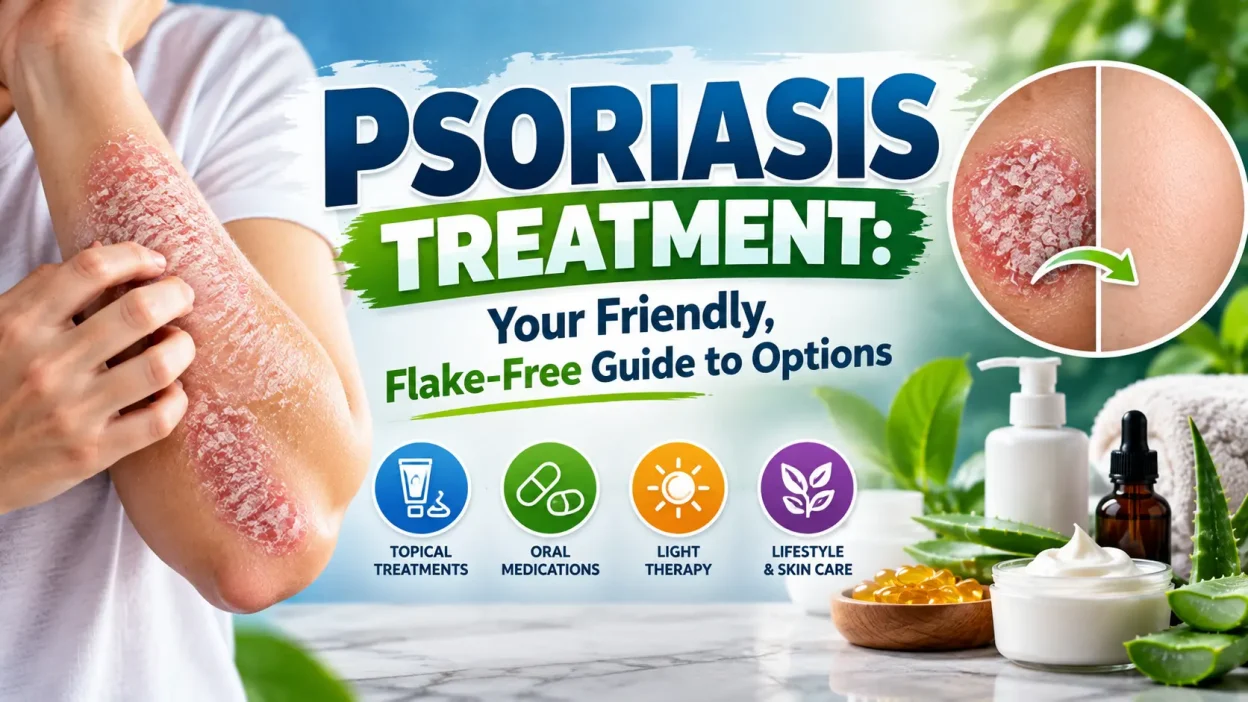
Featuring honest talk about itchy plaques, surprising triggers, and the buffet of treatments that actually work
1. Opening: The Skin Condition That Never Got the Memo About Personal Space
Psoriasis is that one houseguest who shows up uninvited, refuses to leave, and occasionally brings friends.
It’s a chronic autoimmune condition where your immune system — the body’s security team — gets a little too enthusiastic and starts attacking your own skin cells . The result? Skin cells that normally take about a month to rise to the surface and shed now do it in just a few days. They pile up. They form thick, scaly patches. And they itch in a way that makes you seriously consider whether sandpaper might actually feel better .
Worldwide, psoriasis affects roughly 1–3% of the population . That’s millions of people walking around with what looks like a permanent case of “I forgot to moisturize for six years.” But here’s the thing: psoriasis isn’t just dry skin. It’s an immune system misfire with real physical and emotional weight.
The good news? Psoriasis treatment has never been better. We’re living in a golden age of options — from creams you apply at home to biologics that target specific immune pathways with surgical precision.
This guide is your friendly, flake-free tour of psoriasis treatment. We’ll cover the classics, the newcomers, and the “wait, that works?” approaches. No medical jargon dumps. No judgment. Just clear information, a few laughs, and maybe one bad pun per section (we’ll try to restrain ourselves).
2. What Exactly Are We Treating? A Quick Psoriasis Primer
Before diving into treatments, let’s get clear on what psoriasis actually is — and what it isn’t.
🎯 The Basics: A Speed Problem, Not a Dirt Problem
Psoriasis is not contagious. You can’t catch it from a handshake, a hug, or sharing a towel. It’s an autoimmune condition with a strong genetic component — if someone in your family has it, your odds go up .
The core issue is cell turnover speed. Normally, skin cells mature and shed invisibly over about a month. With psoriasis, that process accelerates to just a few days. The cells pile up on the surface, creating those signature thick, red patches with silvery scales .
😂 The Types: A Brief Field Guide
Psoriasis comes in several flavors, and knowing which one you have matters for treatment:
Plaque psoriasis is the most common — more than 80% of cases . It shows up as raised, inflamed patches covered in silvery scales, often on elbows, knees, scalp, and lower back .
Guttate psoriasis looks like tiny drop-shaped spots, often triggered by strep throat. It’s more common in children and teenagers and sometimes clears up on its own .
Inverse psoriasis hides in skin folds — armpits, groin, under breasts. It’s smoother and less scaly than plaque psoriasis, but friction and sweating make it worse .
Pustular psoriasis involves pus-filled blisters (not contagious!) and can be serious .
Erythrodermic psoriasis is rare and severe — nearly all the skin turns red and scaly. This one needs immediate medical attention .
Nail psoriasis causes pitting, thickening, and discoloration of fingernails and toenails .
🌟 The Extras: When Psoriasis Brings Friends
About 30% of people with psoriasis also develop psoriatic arthritis — joint pain, stiffness, and swelling . Other associated conditions include cardiovascular issues, obesity, high blood pressure, and diabetes .
This is why psoriasis treatment isn’t just about skin. It’s about whole-body health.
3. The Psoriasis Treatment Buffet: An Overview
Psoriasis treatment generally falls into three main categories, plus combination approaches:
Topical treatments — creams, ointments, and lotions applied directly to the skin. Best for mild to moderate psoriasis .
Phototherapy (light therapy) — controlled exposure to ultraviolet light, either natural or artificial .
Systemic treatments — medications taken orally or by injection that work throughout the body. For moderate to severe psoriasis .
Combination therapy — mixing and matching from the above, often allowing lower doses of each .
The right approach depends on severity (how much body surface is affected), location (scalp, nails, and palms are trickier), type of psoriasis, and your overall health .
Now let’s dig into each category.
4. Topical Treatments: The First Line of Defense
For mild psoriasis — typically defined as affecting less than 3–5% of body surface area — topicals are the go-to .
🎯 Corticosteroids: The Reliable Workhorse
Topical corticosteroids are the most commonly prescribed treatment for mild psoriasis. They reduce inflammation and slow down the rapid skin cell turnover .
They come in different strengths, from mild (hydrocortisone) to very potent. Your doctor will match the strength to the location and severity. A word of caution: long-term use of potent steroids can thin the skin, so they’re often used in rotation or for short bursts.
😂 Vitamin D Analogues: The Sunshine in a Tube
Calcipotriene (a synthetic vitamin D) is a mainstay for mild to moderate plaque psoriasis. It slows skin cell growth and helps flatten plaques .
The catch? It can irritate sensitive areas. The workaround? Combine it with a steroid in a single product — convenience and effectiveness in one tube.
🌟 Newer Non-Steroidal Options
The topical world has been busy. Newer agents like tapinarof (an aryl hydrocarbon receptor agonist) and roflumilast (a PDE-4 inhibitor) offer steroid-free alternatives . These are especially welcome for long-term use on sensitive areas like the face and skin folds.
Other Topicals Worth Knowing
- Coal tar preparations: Old-school but still useful. They reduce scaling and itching. The smell is… memorable.
- Salicylic acid: Helps lift scales so other treatments can penetrate better .
- Anthralin: Effective but stains everything it touches. Use with caution and old pajamas.
- Calcineurin inhibitors: Often used for facial or inverse psoriasis where steroids are riskier .
- Tazarotene: A topical retinoid that slows cell turnover .
5. Phototherapy: Let There Be (Controlled) Light
Sunlight has been used to treat psoriasis for centuries. Modern phototherapy harnesses specific wavelengths of ultraviolet light to reduce inflammation and slow skin cell growth .
🎯 Narrowband UVB (NB-UVB)
This is the most common form of phototherapy. It uses a specific wavelength of UVB light that’s effective for psoriasis with minimal burning risk. Treatment typically involves 2–3 sessions per week in a dermatologist’s office .
😂 PUVA: The Drug-and-Light Combo
PUVA pairs a light-sensitizing medication (psoralen) with UVA light. It’s effective but requires more monitoring and carries a higher long-term skin cancer risk than NB-UVB .
🌟 Laser and Excimer Light
For stubborn, localized plaques, targeted laser or excimer light can deliver high doses to specific spots without exposing the whole body.
The bottom line: Phototherapy is a solid option for moderate psoriasis or for those who want to avoid systemic medications. It requires commitment — multiple office visits — but the results can be excellent .
6. Systemic Treatments: When Topicals Aren’t Enough
If psoriasis covers a lot of your body, affects your quality of life significantly, or involves joints, systemic treatment becomes the conversation .
🎯 Traditional Oral Medications
Methotrexate is one of the oldest systemic treatments for psoriasis. It suppresses the immune system and reduces inflammation. It requires regular blood monitoring .
Cyclosporine works fast but is typically used short-term due to kidney and blood pressure concerns .
Acitretin is an oral retinoid. It’s effective for severe plaque and pustular psoriasis, but it’s a powerful teratogen — pregnancy must be avoided for years after treatment .
😂 The Biologics Revolution
Biologics are the rock stars of modern psoriasis treatment. These are engineered proteins (usually monoclonal antibodies) that target specific immune pathways with remarkable precision .
TNF inhibitors: Etanercept, adalimumab, infliximab, certolizumab. These block tumor necrosis factor, a key inflammatory signal .
IL-17 inhibitors: Secukinumab, ixekizumab, brodalumab, bimekizumab. These target the IL-17 pathway, which is central to psoriasis inflammation .
IL-23 inhibitors: Guselkumab, risankizumab, tildrakizumab. These block IL-23, which drives the survival of the immune cells that produce IL-17 .
IL-12/23 inhibitor: Ustekinumab targets both cytokines .
Biologics are typically given by injection or infusion. They’re highly effective — many people achieve clear or almost-clear skin — but they require monitoring for infections and other potential side effects .
🌟 Small Molecules: The Oral Newcomers
Apremilast is an oral PDE-4 inhibitor. It’s less effective than biologics but avoids injections and has a favorable safety profile .
Deucravacitinib is an oral TYK2 inhibitor that’s shown strong efficacy for plaque psoriasis. It’s a once-daily pill that’s been a welcome addition for people who prefer oral therapy .
JAK inhibitors like tofacitinib are used for psoriatic arthritis and show promise for psoriasis, though more research is needed for skin-only use .
7. Treating the Tricky Spots: Scalp, Nails, and Palms/Soles
Some areas are just harder to treat. Here’s the scoop:
🎯 Scalp Psoriasis
Scalp psoriasis affects up to 80% of people with psoriasis. It’s visible, itchy, and annoying .
Treatment usually starts with topical steroids in solution, foam, or shampoo form. Vitamin D analogues and coal tar shampoos help with scaling. For stubborn cases, biologics have shown excellent efficacy for scalp involvement .
😂 Nail Psoriasis
Nail psoriasis is stubborn. Topical treatments rarely penetrate the nail plate well. Options include steroid injections into the nail matrix, topical calcipotriol, and biologics .
🌟 Palmoplantar Psoriasis
Psoriasis on palms and soles is thick, painful, and can make walking or using hands miserable. Systemic retinoids like acitretin are particularly effective here . Biologics and phototherapy can also help.
8. What Triggers Flares (and How to Handle Them)
Psoriasis is a come-and-go condition. Flares can be triggered by a variety of factors .
🎯 Common Triggers
Stress is one of the most common. The cruel irony? A psoriasis flare causes stress, which makes the flare worse. Relaxation techniques aren’t just nice — they’re treatment-adjacent .
Infections — especially strep throat — can trigger guttate psoriasis. Anything that revs up your immune system can set off a flare .
Skin injury — a phenomenon called the Koebner response means that cuts, scrapes, sunburns, and even vaccinations can cause new plaques to appear at the injury site .
Weather — cold, dry weather is a common trigger. Warm, humid weather often improves psoriasis .
Medications — certain drugs (including some for malaria, bipolar disorder, and blood pressure) can worsen psoriasis .
😂 Tracking Your Triggers
The National Psoriasis Foundation offers a flare guide and symptom tracker. Logging your symptoms and potential triggers can help you identify patterns and take control .
9. The Tips Section: How to Use This Information Effectively
Here’s how to turn this article from “interesting reading” into “actionable knowledge”:
🎯 For Your Doctor’s Visit
Bring a list. Note where your plaques are, how long they’ve been there, what treatments you’ve tried, and what triggers seem to worsen your symptoms. This helps your dermatologist tailor treatment faster.
😂 For Daily Life
Moisturize religiously. Dry skin itches more and cracks more. Thick creams and ointments (not thin lotions) are your friends.
Take lukewarm, not hot, showers. Hot water strips oils and can irritate plaques.
Get some sun — but not too much. Controlled sun exposure can help, but sunburn triggers flares .
Manage stress. Whatever works for you: meditation, exercise, deep breathing, or listening to whale sounds while pretending you’re not stressed. It all counts.
🌟 For Understanding Your Treatment
Give treatments time. Psoriasis treatments don’t work overnight. Topicals may take weeks. Biologics can take months to reach full effect.
Be honest about side effects. If a treatment is causing problems, tell your doctor. There’s almost always another option .
Combination often wins. Your doctor may combine topicals, light, and systemic treatments to maximize results while minimizing doses .
10. FAQ: Psoriasis Treatment Questions, Answered
Q1: What is psoriasis treatment?
Psoriasis treatment refers to the various medical approaches used to manage the symptoms of psoriasis — a chronic autoimmune condition that causes thick, scaly, inflamed skin patches. Treatment aims to reduce inflammation, slow skin cell turnover, and improve quality of life. Options range from topical creams for mild cases to biologics and oral medications for moderate-to-severe disease .
Q2: Why do people struggle to find the right psoriasis treatment?
Because psoriasis is personal. What works brilliantly for one person may do nothing for another. Genetics, disease severity, location, and overall health all play a role. It often takes trial and error — and sometimes a combination of approaches — to find the right fit. The good news is that the treatment landscape has expanded dramatically, offering more options than ever before .
Q3: Is there a cure for psoriasis?
Not yet. Psoriasis is a chronic condition, and current treatments aim to manage symptoms rather than eliminate the disease entirely. However, many people achieve long periods of clear or almost-clear skin with modern treatments. Research continues to advance, with new targeted therapies and precision medicine approaches on the horizon


