

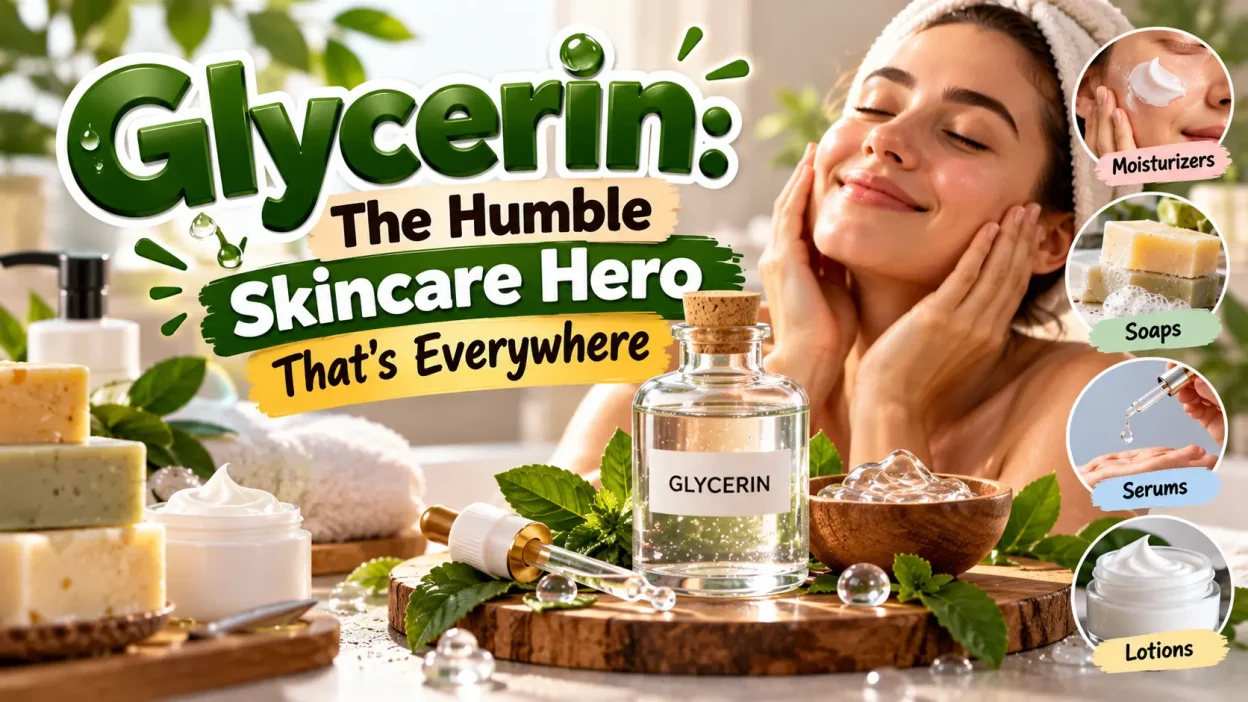
Featuring honest science, zero miracle promises, and one very confused bottle of lotion
Opening: The Ingredient You’ve Never Noticed (But Can’t Live Without)
Glycerin is the quiet kid in the back of the classroom who somehow gets straight A’s.
You’ve never heard anyone rave about it. It doesn’t have a fan club. It doesn’t get its own TikTok hashtag. And yet, it’s in almost everything you put on your body. Your moisturizer. Your toothpaste. Your shampoo. Your soap. Even your wound dressings.
Here’s the funny part: glycerin (also called glycerol) is a substance your own body produces naturally . It’s a component of your cell membranes. It’s involved in energy metabolism. It’s not some exotic lab creation — it’s you.
But here’s the even funnier part: despite being everywhere, most people have no idea what it actually does.
So what’s the deal? Is glycerin a miracle ingredient or just a cheap filler? Does it actually hydrate your skin, or is it just good at pretending?
This guide is your friendly, science-backed tour of the glycerin universe. We’ll cover what it is, what it actually does for your skin and body, and why the evidence is stronger in some areas than others. No miracle promises. No “turn back the clock” nonsense. Just honest information with a few laughs along the way.
Let’s untangle this humble humectant.
What Exactly Is Glycerin?
🎯 The Basics: Your Body Already Makes It
Glycerin is a simple, colorless, odorless liquid. Chemically, it’s a trihydroxy alcohol — meaning it has three hydroxyl groups that love water .
Your body produces glycerin naturally as part of fat metabolism. It’s also found in foods as a moisture retainer and sweetener . When you ingest it, it’s rapidly absorbed and metabolized by your liver and kidneys .
In skincare and medicine, glycerin is used as a humectant — a substance that attracts, binds, and holds moisture . It pulls water from the air (or from deeper layers of your skin) and keeps it in the outer layer, making your skin feel softer and look plumper.
😂 The “Glycerin vs. Glycerol” Confusion
Here’s a fun fact: glycerin and glycerol are the same thing. “Glycerin” is the common name used in cosmetics and food. “Glycerol” is the scientific name used in chemistry and medicine.
It’s like the difference between “soda” and “pop” — same thing, different regional accents. Or “tomato” and “to-mah-to.” You get the idea.
🌟 It’s Been Around Forever
Glycerin isn’t a trendy new ingredient. It’s been used in dermatological preparations for many years . The FDA has recognized it as Generally Recognized as Safe (GRAS) as a food additive since 1975 . The European Food Safety Authority concluded in 2017 that there’s no safety concern regarding its use as a food additive .
This is not a flash in the pan. This is a proven, boring, reliable workhorse. And that’s exactly why it’s so good.
The Skin Story: Where Glycerin Actually Shines
🎯 The Evidence Is Strong Here
If there’s one area where glycerin has rock-solid scientific backing, it’s skin hydration.
A 2008 review published in the British Journal of Dermatology summarized glycerin’s effects on the skin. The findings were impressively consistent: glycerin improves stratum corneum hydration (the outer layer of your skin), improves skin barrier function, and improves skin mechanical properties .
Translation: it makes your skin softer, stronger, and more resilient.
The review also noted that glycerin helps protect against irritating stimuli, enhances desmosomal degradation (which is important for skin cell turnover), and even accelerates wound healing .
😂 The Atopic Dermatitis Connection
Glycerin has been specifically studied in people with dry, eczematous skin — including atopic dermatitis.
Clinical trials have compared glycerin to other moisturizing ingredients like urea. One 2002 study found that glycerin-containing creams improved skin barrier function in patients with atopic dermatitis . Another trial compared glycerin and urea directly in patients with dry skin .
The takeaway: if you have dry skin or a compromised skin barrier (which happens with conditions like eczema), glycerin is your friend. It’s not a cure for eczema, but it’s an excellent supportive ingredient.
🌟 The Moisturizing Mechanism
Here’s why glycerin works so well: it’s a humectant . It draws water into the skin and holds it there.
This is different from occlusives like petroleum jelly, which form a barrier on top of the skin to prevent water loss. Glycerin works from within, pulling moisture into the skin rather than just sealing it in.
Think of glycerin as a sponge and petroleum jelly as a raincoat. Both keep you dry, but they do it in completely different ways. The best moisturizers often contain both.
The Body Story: Glycerin Beyond Skin
🎯 Constipation Relief: The Suppository Option
Glycerin isn’t just for the outside of your body. It’s also used as a glycerin suppository for occasional constipation .
How does it work? Glycerin is a hyperosmotic agent. When placed in the rectum, it draws water into the stool, softening it and stimulating the urge to go .
A 2023 clinical trial compared glycerin to bisacodyl (another laxative) in children undergoing colonic manometry. The study looked at high-amplitude propagated contractions — the waves that move stool through the colon .
Glycerin suppositories are commonly used in premature infants to facilitate meconium evacuation . This is a medical procedure, not a home remedy, and should only be done under medical supervision.
Important caveat: Glycerin suppositories are for occasional use. They’re not a long-term solution for chronic constipation.
😂 The Food Additive Reality
Glycerin is also a food additive (E 422 in the EU) . It’s used as a humectant, solvent, and sweetener.
In 2017, the European Food Safety Authority re-evaluated glycerin as a food additive. Their conclusion: no safety concern at the refined exposure assessment for reported uses. They noted that glycerin has low acute toxicity and did not raise concern for genotoxicity or carcinogenicity .
The panel did note that local irritating effects in the gastrointestinal tract (seen in some animal studies) were likely due to glycerin’s hygroscopic and osmotic effects — meaning it pulls water into the gut, which can cause irritation at high doses .
Translation: eating a lot of glycerin might give you a stomachache. Using it in normal food amounts is fine.
🌟 The Pharmaceutical Excipient
Glycerin is also used as an excipient in many medications. An excipient is an inactive ingredient that helps deliver the active drug .
In a 2026 FDA review of a hydrocortisone oral solution, glycerin was noted as an excipient. The review mentioned that glycerin is “rapidly and near completely absorbed when ingested” and is metabolized in the liver and kidneys .
The review also raised concerns about high doses of glycerin in pediatric patients, particularly those under 5 years old. The maximum daily dose of glycerin from that product ranged from 256.8 mg/kg/day (17-year-old) to 746.5 mg/kg/day (newborn) . For pediatric patients over 1 year old, this was comparable to or less than glycerin exposures from natural sources .
The Safety Story: What You Need to Know
🎯 Topical Use: Generally Safe
For most people, topical glycerin is well-tolerated. The 2008 review noted that glycerin-containing products improve skin properties in conditions characterized by dryness and impaired barrier function .
However, there’s a catch: glycerin is a humectant, which means it pulls water. In very dry environments, it might pull water from your skin instead of from the air. This is why glycerin is usually combined with occlusives in moisturizers.
😂 The Hyperosmolarity Risk (When Swallowed or Injected)
The FDA review mentioned several safety concerns associated with glycerin when used in high doses, especially in pediatric patients :
- Hyperosmolarity
- Metabolic acidosis
- Hypoglycemia
- Hepato-renal injury
- Cardiovascular toxicity
- Central nervous system toxicity (seizure, coma)
- Gastrointestinal adverse reactions
These are concerns for high-dose oral or intravenous use, not topical application .
There’s also a case report from 2024 describing transient hyperlactatemia (elevated lactate) after intravenous glycerin administration in a patient with brain trauma . And a 1982 case report described hyperosmolality caused by percutaneously absorbed glycerin in a burn patient .
Again: these are extreme scenarios. But they illustrate that glycerin isn’t completely inert, especially at high doses or on compromised skin.
🌟 The Bottom Line on Safety
For topical cosmetic use: glycerin is safe and well-tolerated.
For food additive use: the EFSA concluded no safety concern at normal exposure levels .
For high-dose medical use: there are real risks, which is why it’s used under medical supervision.
Glycerin in Cosmetics: Why It’s in Everything
🎯 The Humectant Superpower
Glycerin is one of the most common ingredients in skincare for a simple reason: it works.
It’s a humectant that attracts water . It’s cheap. It’s stable. It’s compatible with almost every other ingredient. And it has decades of safety data behind it.
A 2024 study in Scientific Reports examined coconut and glycerin moisturizers for preventing hand dermatitis in fabric workers. The trial was randomized, double-blind, and crossover — which means it was a well-designed study . The fact that glycerin was chosen as the active moisturizing ingredient speaks to its established reputation.
😂 The “Cheap Filler” Myth
Some skincare enthusiasts dismiss glycerin as a “cheap filler.” This is unfair.
Yes, glycerin is inexpensive. But inexpensive doesn’t mean ineffective. Some of the most effective ingredients in skincare are also the cheapest: glycerin, niacinamide, zinc oxide, petroleum jelly.
The expensive ingredients — the peptides, the growth factors, the exotic plant extracts — often have weaker evidence than humble glycerin.
🌟 How to Spot Good Glycerin Products
Look for glycerin near the top of the ingredient list. Ingredients are listed in order of concentration. If glycerin is in the first five ingredients, the product contains a meaningful amount.
Also look for products that combine glycerin with occlusives (like petroleum jelly, dimethicone, or shea butter). This combination gives you the best of both worlds: hydration from within and protection from without.
Tips Section: How to Use Glycerin Effectively
🎯 For Skincare
Apply to damp skin. Glycerin works best when there’s moisture to attract. After a shower or bath, pat your skin dry (leave it slightly damp) and apply your glycerin-containing moisturizer immediately.
Layer with occlusives. If you have very dry skin, use a glycerin-rich moisturizer first, then seal it in with an occlusive balm or oil.
Be mindful of humidity. In very dry climates, glycerin might pull moisture from your skin. In that case, use a humidifier or choose products that combine glycerin with occlusives.
😂 For DIY Enthusiasts
Don’t use 100% glycerin. It’s too strong and can actually dehydrate your skin by pulling water from deeper layers. Dilute it with water or other ingredients. A 5–10% concentration is usually plenty.
Patch test first. Even though glycerin is generally safe, everyone’s skin is different. Test on a small area before slathering it everywhere.
Store it properly. Glycerin is hygroscopic — it absorbs water from the air. Keep it tightly sealed.
🌟 For General Wellness
Don’t drink it for “detox.” There’s no evidence that drinking glycerin does anything beneficial for healthy people. And in high doses, it can cause gastrointestinal distress .
Use glycerin suppositories only as directed. They’re for occasional constipation, not daily use. Follow the package instructions or your doctor’s advice.
FAQ: Your Glycerin Questions, Answered
Q1: What is glycerin?
Glycerin (also called glycerol) is a colorless, odorless liquid that’s a natural component of your body’s cells. It’s used as a humectant in skincare, a food additive, and a pharmaceutical excipient. It attracts and holds moisture, making it an excellent moisturizing ingredient .
Q2: Why do people use glycerin in skincare?
Because it works. Glycerin is a humectant that improves skin hydration, skin barrier function, and skin mechanical properties. It’s been studied in clinical trials for dry skin and atopic dermatitis, with consistently positive results . It’s also cheap, stable, and safe.
Q3: Is glycerin safe?
For topical use, yes. For food additive use, the EFSA concluded no safety concern at normal exposure levels . For high-dose oral or intravenous use, there are real risks (hyperosmolarity, metabolic acidosis, etc.), which is why medical use is supervised . For normal skincare and food use, glycerin is safe.


[…] take L-carnitine for weight loss, exercise performance, heart health, and male fertility. The evidence is strongest for male fertility and cardiac surgery recovery, […]