Featuring honest science, zero gross-out images, and one very confused woodpecker
1. Opening: When a Honeycomb Becomes a Horror Movie
There are two types of people in the world.
Type A: sees a lotus seed pod and thinks, “Oh, how interesting. Nature is neat.”
Type B: sees a lotus seed pod and immediately wants to crawl out of their own skin, scratch their arms, and possibly flee the continent.
If you’re Type B, congratulations — you might have trypophobia.
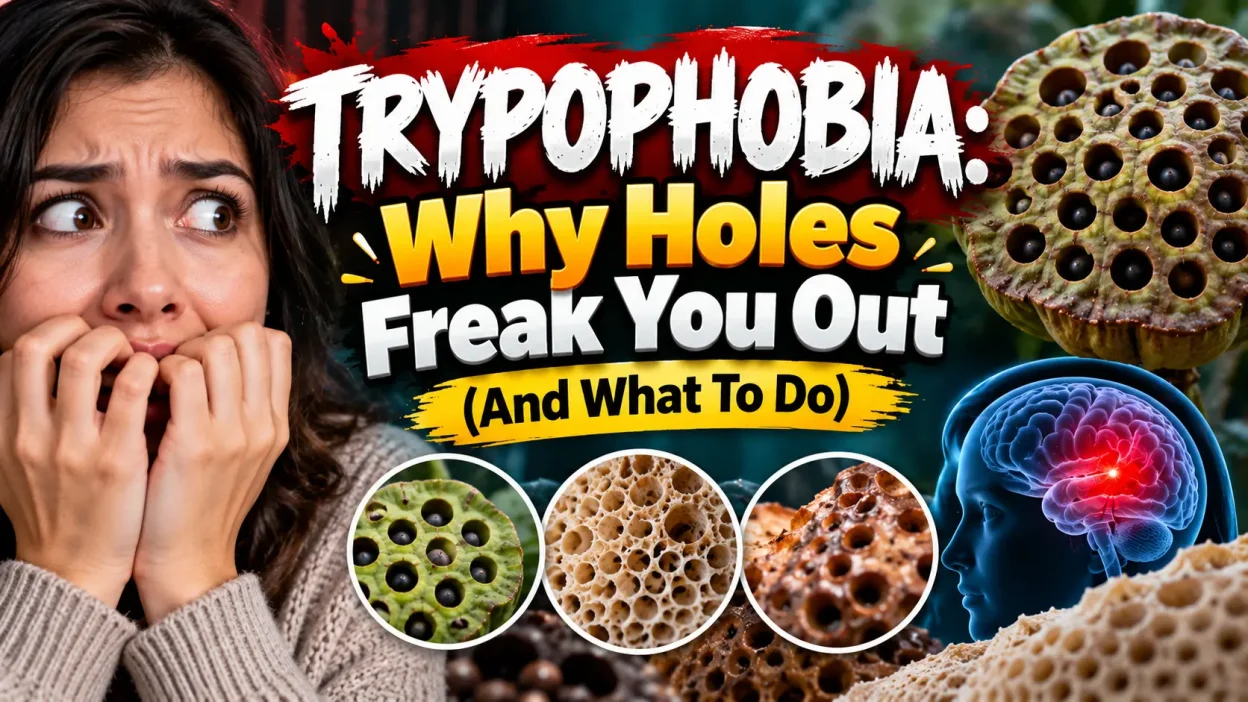
Trypophobia is the intense aversion or fear triggered by clusters of small holes, bumps, or repetitive patterns . We’re talking honeycombs, sponges, bubble wrap, strawberry seeds, porous rocks, and that one woodpecker photo that broke the internet back in 2019 .
Estimates suggest that anywhere from 10% to 18% of adults experience some level of anxiety when viewing these patterns . That’s a lot of people quietly suffering through breakfast cereal advertisements.
This guide is your friendly, itch-free tour of trypophobia. We’ll explore what it actually is (spoiler: it might be more disgust than fear), why your brain does this weird thing, and what you can do about it. We’ll also clear up the biggest misconception: you’re not “weak” or “being dramatic.” Your brain is just running an ancient survival program that’s a little too enthusiastic.
Let’s dig in. But not too deep. We don’t want to trigger anyone.
2. What Exactly Is Trypophobia?
🎯 The Basics: A Name That Means “Fear of Holes”
The word “trypophobia” comes from the Greek trypa (hole) and phobos (fear) . It was coined in 2005 by a user on an online forum, which is perhaps the most 2005 thing that has ever happened .
But here’s the twist: trypophobia is not officially recognized as a distinct phobia in the DSM-5 or the ICD-11 . This has led to some skepticism. Is it a real condition, or just an internet meme that got out of hand?
The answer is more nuanced than a simple yes or no.
😂 The Fear vs. Disgust Debate
Here’s where trypophobia gets interesting. Unlike typical phobias — where the dominant emotion is fear (fear of spiders, fear of heights, fear of clowns) — trypophobia’s primary emotional signature appears to be disgust .
Think about it. When you see a cluster of holes, you don’t usually think, “This will physically harm me.” You think, “Ew. Ew ew ew. Why does this exist. Get it away from me.”
That’s disgust. That’s your brain saying, “This pattern looks like something diseased, infested, or rotten. Do not touch. Do not ingest. Maybe leave the room.”
Researchers have found that trypophobic reactions involve a mixed physiological response — some signs of sympathetic activation (heart racing, sweating) and some signs of parasympathetic activation (nausea, dizziness) . It’s like your body can’t decide whether to fight, flee, or just lie down and wait for the feeling to pass.
🌟 So Is It a Real Phobia or Not?
Geoff Cole, a researcher who has published extensively on trypophobia, argues that it is a phobia — just not one that fits neatly into existing categories . The DSM-5 doesn’t actually contain a list of approved phobias; it contains criteria for classifying phobias . By those criteria, trypophobia qualifies.
But many researchers prefer the term “aversion” because it’s more accurate and less pathologizing . Not everyone who feels uncomfortable looking at a sponge has a clinical disorder. Some people just find it gross. And that’s valid too.
3. The Triggers: A Field Guide to Things That Make People Squirm
Trypophobia triggers are remarkably consistent across cultures and individuals. Here’s the rogue’s gallery:
😂 The Classic Offenders
- Lotus seed pods: The undisputed king of trypophobia triggers. If you’ve never seen one, imagine a showerhead made of nightmares.
- Honeycombs: Delicious, yes. But also a cluster of hexagons that some brains interpret as “danger.”
- Sponges: Natural sea sponges are gorgeous. They’re also a cluster of holes. Sorry.
- Bubble wrap: Theoretically satisfying to pop. Visually, a field of tiny circles.
- Strawberries: The seeds. People with trypophobia have reported struggling with this beloved fruit .
- Pomegranates: A fruit that is essentially a cluster of ruby-red chambers. Beautiful to some, unsettling to others.
- Porous rocks and coral: Nature’s way of saying “look at all these holes.”
- Woodpecker trees: The 2019 internet moment. A tree filled with acorn-storing holes triggered mass revulsion online .
🎯 The Human Element
Here’s where it gets personal: some people with trypophobia are triggered by human skin conditions — acne, scars, rashes, or clustered lesions . This is particularly difficult because it can lead to avoidance of social situations or even fear of one’s own skin.
This connection to skin disease is important. It supports the idea that trypophobia is rooted in disease avoidance — an evolutionary mechanism designed to keep us away from things that might be contagious .
4. Why Does This Happen? The Brain’s Weird Logic
🎯 The Evolutionary Hypothesis: “Better Safe Than Sorry”
The leading theory is that trypophobia is an overgeneralized disease-avoidance response .
Think about it from an evolutionary perspective. Our ancestors needed to avoid things that could kill them: poisonous animals, infectious skin conditions, parasitic infestations. Many of these threats share a visual signature: clusters of small, irregular shapes with high contrast .
Venomous snakes like the blue-ringed octopus? Their patterns match the spectral properties of trypophobic images . Skin lesions from smallpox or measles? Clustered, irregular, alarming.
So our brains evolved a simple rule: “Clustered holes and bumps = potential danger. Avoid.”
The problem is that this rule is too broad. It flags honeycombs and sponges as threats when they’re completely harmless. Your brain is essentially a security system that goes off every time a leaf rustles.
😂 The Visual Processing Hypothesis: Your Brain Is Just Overwhelmed
Another theory focuses on how our brains process visual information.
Trypophobic images have a specific spectral signature: high contrast at mid-range spatial frequencies . In plain English, they contain a lot of visual “noise” that our brains find difficult to process efficiently.
This can cause visual discomfort — eyestrain, headache, squinting — which some people interpret as emotional distress . Your brain is working overtime to parse the image, and it doesn’t like the effort.
🌟 The Two Theories Aren’t Mutually Exclusive
Here’s the elegant part: both theories can be true simultaneously.
Your brain evolved to flag certain visual patterns as dangerous (disease avoidance). Those patterns happen to be the same ones that are visually taxing to process (visual stress). So you get a double whammy: your threat-detection system fires and your visual system struggles.
No wonder you want to scratch your arms.
5. Symptoms: What It Actually Feels Like
Trypophobia symptoms vary from mild discomfort to full-blown panic. Here’s the spectrum:
🎯 The Mild End
- Mild discomfort: “Huh, this image is kind of gross.”
- Avoidance: Scrolling past certain images quickly.
- Slight itching: A faint urge to scratch your arms.
😂 The Moderate End
- Nausea: That queasy feeling you get from something deeply unappetizing.
- Goosebumps: Your skin is literally trying to crawl .
- Rapid heartbeat: Your body is preparing for… something.
- Sweating: Because your brain thinks you’re in danger.
- Dizziness: The room might feel a little off.
🌟 The Severe End
- Panic attacks: Full sympathetic nervous system activation .
- Intense disgust: An overwhelming sense that the stimulus is contaminated, diseased, or rotten .
- Compulsive scratching: Some people report scratching at their skin until it hurts .
- Vomiting: In extreme cases.
The key distinction: trypophobia isn’t just “this image is ugly.” It’s a visceral, involuntary reaction that you can’t easily control. You can’t logic your way out of it in the moment.
6. Trypophobia and Skin Conditions: A Complicated Relationship
This deserves its own section because it’s often overlooked.
Trypophobia has a special relationship with dermatology . People with skin conditions — acne, eczema, psoriasis, scarring — may experience heightened distress because:
- Their own skin triggers their phobia
- They fear judgment from others who might be triggered
- The condition itself creates clustered, irregular patterns
This can lead to a vicious cycle: skin condition → trypophobic distress → stress → worsened skin condition → more distress.
If you’re dealing with both, know that you’re not alone. And consider talking to a dermatologist and a mental health professional. They can work together.
7. Can You Treat Trypophobia?
There’s no officially validated treatment protocol specifically for trypophobia, but approaches used for other phobias show promise .
🎯 Cognitive Behavioral Therapy (CBT)
CBT helps you identify and challenge the thoughts that fuel your reaction. For trypophobia, this might involve:
- Recognizing that the holes are not actually dangerous
- Challenging the disgust response
- Building tolerance through gradual exposure
Case studies have shown improvement in fear symptoms with CBT, though disgust responses tend to be more stubborn .
😂 Exposure Therapy
Gradual, controlled exposure to trypophobic stimuli — starting with mild triggers and working up — can help desensitize your brain .
The key is gradual. You don’t start with a lotus seed pod. You start with something barely triggering, and you practice staying calm while looking at it. Over time, your brain learns that the pattern isn’t a threat.
🌟 One-Session Treatment (OST)
Recent research has explored One-Session Treatment — a concentrated 3-hour CBT session that combines psychoeducation, cognitive challenges, and prolonged exposure . This approach has worked well for other phobias like spider phobia and claustrophobia.
For trypophobia, researchers are developing protocols that address both fear and disgust components, since exposure alone may not fully resolve disgust .
🎯 Relaxation and Mindfulness
When you encounter a trigger, your body goes into stress mode. Relaxation techniques — deep breathing, progressive muscle relaxation, mindfulness — can help regulate your nervous system .
It’s not a cure, but it’s a coping tool. Think of it as a fire extinguisher for your nervous system.
😂 Medication
In severe cases, doctors may prescribe SSRIs or beta-blockers to manage anxiety symptoms . This is typically a last resort, but it can be helpful if trypophobia is severely impacting daily life.
8. The Tips Section: How to Manage Trypophobia in Daily Life
If you have trypophobia, here’s how to navigate a world that is absolutely full of holes:
Curate your content. Social media algorithms love trypophobia-triggering images. Unfollow accounts that post them. Use content filters. Your mental health is worth more than a few extra likes.
Practice grounding. When you encounter a trigger, focus on your physical environment. Name five things you can see, four you can touch, three you can hear. This pulls your brain out of the disgust spiral.
Don’t shame yourself. Your brain is doing what brains do. It’s running ancient software on modern hardware. You’re not “weak” or “dramatic.”
Communicate your needs. If a friend shows you a photo that triggers you, it’s okay to say, “Hey, that pattern really bothers me. Can we skip it?” Most people will understand.
Seek professional help if needed. If trypophobia is causing significant distress or avoidance, a therapist trained in CBT or exposure therapy can help .
9. FAQ: Your Trypophobia Questions, Answered
Q1: What is trypophobia?
Trypophobia is an intense aversion or fear triggered by clusters of small holes, bumps, or repetitive patterns. It’s not officially recognized in the DSM-5 or ICD-11, but research suggests it affects 10–18% of adults to some degree .
Q2: Why do people have trypophobia?
The leading theory is that it’s an evolutionary overgeneralization of a disease-avoidance response. Our brains evolved to avoid patterns that resemble infectious skin conditions or poisonous animals, and trypophobia is that system firing at harmless stimuli .
Q3: Is trypophobia curable?
There’s no “cure,” but it can be managed. CBT, gradual exposure therapy, and relaxation techniques have shown promise . Many people find that their reactions become less intense with practice and time.