

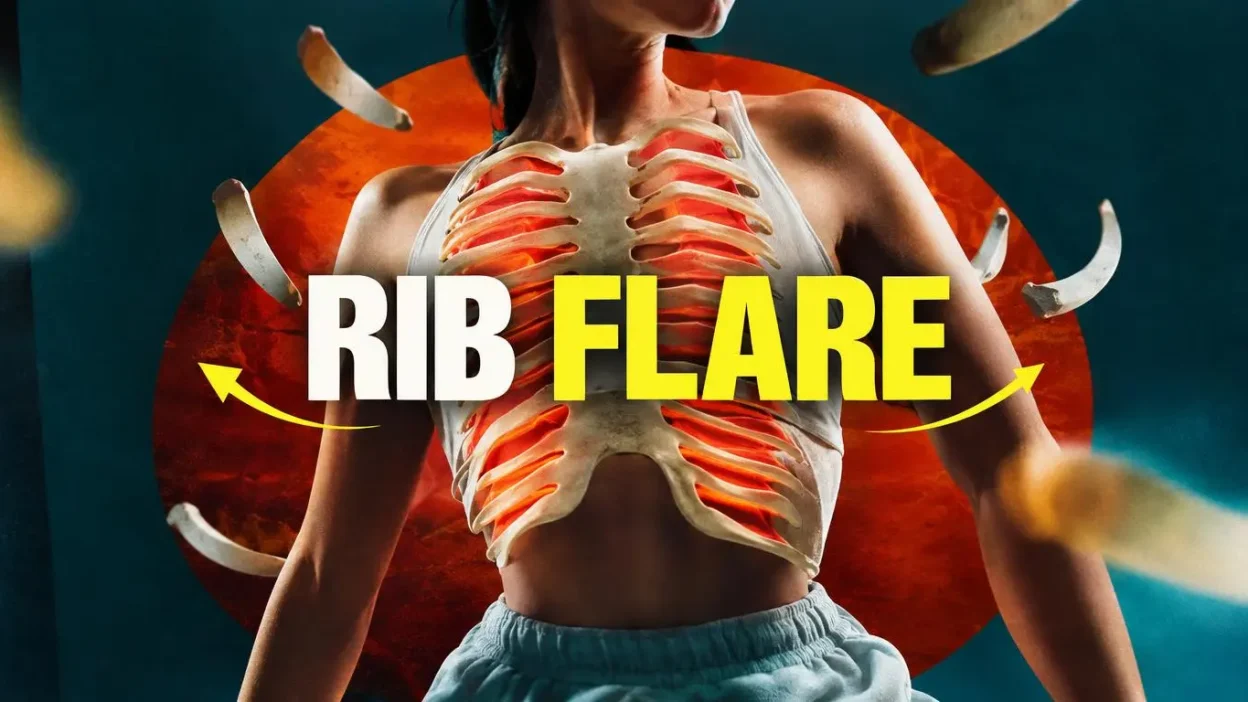
Have you ever looked in the mirror, taken a deep breath, and noticed that your lower ribs seem to be trying to escape your body? Or maybe you’ve caught a glimpse of yourself in a shop window and thought, “Huh, my ribs are looking a little… enthusiastic today.”
Welcome to the world of rib flare.
If you’ve been scrolling through fitness videos or health forums lately, you’ve probably seen the term pop up. It sounds a bit dramatic, almost like your ribs are having a party without inviting the rest of your torso. But what exactly is it? And is it something to worry about, or is it just your body’s unique way of saying hello to the world?
In this guide, we’re going to unpack what is rib flare in a way that’s easy to understand, sprinkle in a little humor, and leave you feeling informed rather than overwhelmed. Think of this as your friendly, judgment-free zone for all things rib-related.
What Is Rib Flare? The Simple Explanation
So, what is rib flare? In the simplest terms, rib flare is when the lower ribs (usually ribs 7 through 10) stick out more prominently than usual . Instead of curving neatly inward toward your abdomen, they decide to go their own way and angle outward.
Imagine your rib cage is like a birdcage. Ideally, the bottom of that cage curves in smoothly to meet your waist. With rib flare, the bottom bars of the cage are pushed outward, creating a little shelf or a flare at the bottom.
It’s not a disease. It’s not a defect. It’s simply a position—a shape your body has adopted for one reason or another. And here’s the kicker: for many people, it’s completely normal and harmless . It might just be how their skeleton is built.
But for others, it can be a sign that something in the body’s alignment or breathing mechanics is a little out of sync.
Why Do Ribs Decide to “Flare”? The Usual Suspects
Your ribs don’t just wake up one morning and decide to be rebellious. There are usually a few friendly culprits behind the curtain. Let’s meet them.
-
The “Suck It In” Effect: This is a big one, especially for women . For years, we’ve been told to “suck in our stomachs” to look slimmer. But here’s the thing: when you constantly pull your belly button toward your spine, you’re not just flattening your tummy. You’re also preventing your diaphragm from doing its job properly. This creates pressure that pushes your lower ribs outward. It’s like trying to close a door while someone is pushing on the other side—eventually, something has to give, and usually, it’s your ribs.
-
The Breathing Pattern Mix-Up: Ideally, we should breathe using our diaphragm, which is the big muscle at the base of our lungs. This allows the ribs to expand out to the sides. But many of us are “chest breathers,” especially when stressed . Chest breathing lifts the shoulders and upper chest, and can cause the lower ribs to flare out as a compensation.
-
Core Strength (or Lack Thereof): Think of your core as a team of muscles that work together to hold your rib cage and pelvis in a good relationship. If the deep abdominal muscles (like the transversus abdominis) are weak or not doing their job, the ribs don’t have the support to stay in their ideal position . They end up relying on other muscles that pull them upward and outward.
-
Posture Habits: If you spend your day hunched over a computer, or if you have a posture that arches your lower back significantly (anterior pelvic tilt), your ribs will follow suit . They get pulled into a flare by the position of your spine.
-
Athletic Aesthetics: In certain sports like gymnastics and dance, a flared rib cage is often a byproduct of the extreme flexibility and shapes required . It’s a position the body gets very good at making.
-
Pregnancy and Growth Spurts: During pregnancy, the ribs naturally flare upward and outward to make room for a growing baby . It’s a temporary (though sometimes uncomfortable) adaptation. Similarly, during rapid growth spurts in childhood and adolescence, the rib cage can change shape.
Is Rib Flare a Problem? When to Pay Attention
Here’s the reassuring part: for many people, rib flare is purely aesthetic. It’s just how they’re built, and it doesn’t cause any issues . If you can breathe deeply, exercise without pain, and feel good, your flared ribs are likely just a unique feature of your anatomy.
However, there are times when rib flare is a sign that something needs a little TLC.
-
Breathing Inefficiency: If your ribs are stuck in a flared position, your diaphragm can’t work effectively. This might make you feel short of breath during exercise or even at rest .
-
Core and Back Pain: A flared rib cage often goes hand-in-hand with an arched lower back. This can lead to back pain over time because the muscles are working overtime to keep you upright .
-
Rib and Chest Discomfort: Sometimes, the joints where the ribs attach to the spine can become irritated, leading to a dull ache or sharp pain in the mid-back or around the rib cage . You might also experience discomfort when laughing hard, which is a cruel twist of fate .
-
Slipping Rib Syndrome: In some rare cases, a flared rib can contribute to a condition where a rib becomes hypermobile and slips over another, causing sharp, burning pain . This requires medical attention.
The key is to listen to your body. If your ribs are just there, looking a bit proud of themselves, and causing no trouble, then it’s just a fun fact about your anatomy. If they’re causing pain, breathing issues, or significant distress, it’s worth investigating further with a healthcare professional.
Rib Flare vs. “Rib Thrust”: The Aesthetic Difference
Sometimes you’ll hear the term “rib thrust.” While similar to rib flare, there’s a subtle difference in usage. Rib thrust is often used in the context of dance and gymnastics to describe a specific aesthetic shape where the ribcage is lifted and pushed forward, creating a dramatic arch in the back .
In the fitness world, “rib flare” is the broader term for the anatomical position of the lower ribs. But the underlying mechanics are often the same: an imbalance in the core, breathing, and posture.
The Friendly Fixes: How to Tame (or Befriend) Your Ribs
If you’ve decided that your rib flare could use a little adjustment for comfort or aesthetics, the good news is that there are many gentle, effective ways to encourage your ribs back into a more neutral position. This isn’t about forcing your body into a shape it hates; it’s about giving it new, healthier habits.
-
The Magic of Diaphragmatic Breathing (360-Degree Breathing)
This is the number one tool for addressing rib flare. Instead of breathing into your chest, you want to learn to breathe into your belly, sides, and back.
-
How to do it: Lie on your back with your knees bent. Place your hands on your lower ribs, wrapping them around to the sides. Take a slow, deep breath in through your nose, and focus on feeling your ribs expand out to the sides, like an umbrella opening. Feel your hands rise. Then, exhale slowly through your mouth, feeling your ribs gently drop back inward and down . Repeat this for a few minutes daily.
This simple practice retrains your diaphragm and helps the ribs return to their natural resting position.
-
Engage Your Deep Core (The Right Way)
Remember, this is not about “sucking in.” It’s about gently activating your deep abdominal muscles to act as a support belt for your ribcage.
-
How to do it: Lie on your back. Place your hands just inside your hip bones. Imagine a line drawn between your hip bones. Gently draw that line upward toward your head, and slightly inward. You should feel a subtle tension in your lower abdomen, but your ribs should not move upward or your back should not flatten forcefully . Hold this gentle engagement while you breathe. This is the “core” you want to use for support, not a sucked-in stomach.
-
Stretch the Tight Spots
Often, tight muscles in the front of the chest and the lats (the big muscles on the sides of your back) can pull the ribs into a flare.
-
Doorway Stretch: Place your forearm on a doorframe with your elbow at a 90-degree angle. Gently step forward until you feel a stretch in your chest. Hold for 30 seconds .
-
Thread the Needle: On your hands and knees, slide one arm underneath your body, reaching across to the other side. Let your shoulder and side of your head rest on the ground. This stretches the upper back and ribs. Hold for a few breaths .
-
Check Your Posture
Be mindful of how you sit and stand. Avoid slouching and avoid over-arching your lower back. The goal is a neutral spine where your ribs are stacked over your pelvis, not thrust forward .
Frequently Asked Questions (FAQ)
Q: Is rib flare a sign of a weak core?
A: Not necessarily a “weak” core in the sense of being unable to do a sit-up, but more of an imbalanced core. The deep stabilizing muscles might not be engaging effectively, allowing the ribs to flare .
Q: Can rib flare be fixed permanently?
A: If your rib flare is due to postural habits or breathing patterns, it can be significantly improved with consistent practice. If it’s due to your skeletal structure (how your bones are shaped), you can improve your posture and strength around it, but the shape of the bones themselves may not change dramatically .
Q: Should I worry if my child has rib flare?
A: Many children have rib flare as part of their normal growth and development. However, if it’s accompanied by chest pain, shortness of breath, or significant asymmetry, it’s always best to have a pediatrician check it out .
How to Spot Rib Flare (A Fun Self-Check)
Want to see if you have rib flare? Try this simple, non-scientific test:
-
Stand in front of a mirror without a shirt (or in a fitted top).
-
Place your hands on your lower ribs, right where they meet your waist.
-
Take a deep breath in. Do your ribs move out to the sides, or do they lift up and forward?
-
Exhale fully and relax completely. Now, look at where your lower ribs are. Do they protrude forward more than your upper abdomen? If you can see a distinct “shelf” or angle where the ribs stick out, you’ve likely got some rib flare going on.


