

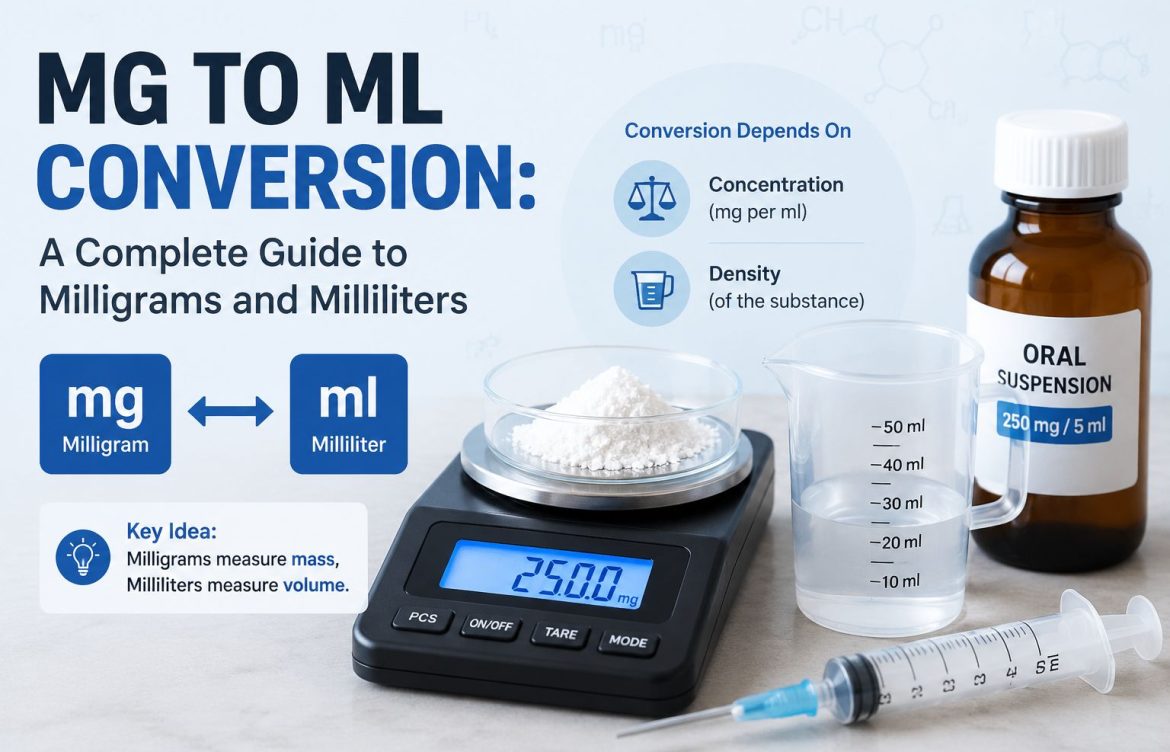
Mg to Ml Conversion: A Complete Guide to Milligrams and Milliliters
So, If you have been looking for mg to ml conversion staring at a medicine bottle or a recipe. This is among the most heavily searched measurement questions on the Internet, and with good reason — milligrams and milliliters look like they ought to be easily convertible; but they measure two entirely different substances. Getting ml to mg conversion right gas in medication dosing, cooking, lab work and even household chores.
In this article, we will explain exactly what milligrams and milliliters measure, how they relate to one another, and how better to convert from ml → mg (or vice versa) with confidence.
Mg vs Ml: What’s the Difference?
It certainly helps to know what each unit measures before you can convert them.
Milligrams (mg) measure the mass of an object, or how heavy something is.
Millilitres (ml) is a measure of volume, or how much space something takes up.
There is no universal answer to the question “ml is how many mg,” as one represents weight and the other space. The answer is entirely dependent on the material you are weighing in it, more specifically the density of that material.
How Many Milliliters Is in a Milligram?
This is asked in many forms pretty regularly and the truthful answer is: it depends what you measure.
The relationship is simple for water at room temperature.Since water has a density of 1 gram per milliliter (1 g/ml). That means:
1 ml of water = 1,000 mg
1 mg of water = 0.001 ml
However, that 1:1000 disposal only works for water or materials with the identical density as water. When you are talking about stuff like oils, syrups, alcohol or medication the numbers become different because of density.
The Role of Density in Mg to Ml Conversion
Density is your link between weight and volume. It shew you the real weight of a particular volume of substance and is measured in grams per milliliter (g/ml).
This is the simple formula for conversion:
Milligrams = Milliliters ¸ Density times 1,000
Or, if you’re going the other way:
ML = MG – ( D × 1000 )
Why this matters: 1 ml of vegetable oil doesn’t weigh the same as 1 ml of water, because of the lower density of oil. Just as 1 ml honey is heavier than 1 ml water because honey is denser. Any mg in mL conversion is really a shot at the dark without knowing the actual density of that particular substance.
Quick Density Reference
| Substance | Approximate Density (g/ml) |
|---|---|
| Water | 1.00 |
| Whole milk | 1.03 |
| Vegetable oil | 0.92 |
| Honey | 1.42 |
| Rubbing alcohol | 0.79 |
Keep in mind these are approximate values, and factors like temperature can shift them slightly.
How to Convert Mg to Ml for Liquid Medications
This is why the mg to ml question is so crucial. Liquid (for examples, medications may be stated as “5 mg/ml” or “250 mg/5 ml”). That means it demonstrates, in milligrams of active ingredient per volume (in this case 1 mL of liquid), eliminating any guessing around density.
10 mg: This is 10 milligrams (mg) of drug in 1 milliliter (ml):
If you wanted to take in 5 mg then 0.5 ml would be needed.
You would need 2 ml to administer this 20 mg.
The formula here is straightforward:
ML = Desired Dose / Concentration
This is exactly why you need to read the label concentrations. Because two liquid medications that contain the same active ingredient can be at totally different concentrations, the ratio of mls to milligrams will vary from one product to another. Make sure to check the label, and if you are not certain, get a pharmacist to verify your dose calculation.
Common Mg to Ml Conversion Scenarios
Healthcare: These conversions are relevant for nurses, caregivers and patients measuring liquid medicine According to mouth- the ml to mg conversion is frequently performed when taking ml as measurement units to prepare dose in mg.
In cooking and bakingRecipes sometimes specify the weight (grams or milligrams) of an ingredient, while at other times they list in volume (milliliters or teaspoons). This is where the density of the ingredient — oil, syrup or extract generally works perfectly.
In the lab: From solutions and reagents to samples, scientists and lab technicians often have to inter-convert between mass and volume, as even minor density-related mistakes can impact results.
Home: If you dilute a cleaning solution or measure out a supplement, it’s helpful to know how to convert ml to mg so that you don’t over- or under-measure.
Tools That Make Mg to Ml Conversion Easier
Although it’s not a large ask, and the conversions are simple once you know the density from experience, converting resources can easily cut down on error rate. Also, lots of pharmacy/medical sites have calculators for dosing key meds that automatically take concentration into account.
Keep in mind, however, that tools are only as good as the data you put in. You should always check the density value or concentration related, especially if you deal with medication, before believing in any calculator.
Key Takeaways
-
Milligrams is a unit of weight; milliliters is a measure of volume — they are not interchangeable.
The key link between the two units is density.
Water is about 1 g / ml; this means that 1 ml of water equals to 1,000 mg.
If estimating, for medications always utilize a labeled concentration (mg/ml), not just assume based on a water-based conversion.
There are online tools that help you arrive at something close, but with dosaging be careful with your inputs.
Frequently Asked Questions
Is 1 mg equal to 1 ml?
No. Milligrams (mg) are a measurement of weight and milliliters (mL) are a measurement of volume which means that they will never be equivalent by default. Conversion is based on the density of the specific substance.
How do I convert mg to ml?
Get the milligrams and divide that by the density of the substance (in mg/ml). For water, divide by 1,000. Do not assume density with medications, use concentration from the package.
Ml is how many mg?
It depends on the substance. 1 ml = 1000 mg for water. However, for other liquids, you will have to obtain the density in order to compute a proper number.
Why can’t I use a single conversion factor for all liquids?
Since different fluids have different densities. The conversion factor that suits water is not appropriate for oil, honey, alcohol or medication; each of these has their own weight-to-volume relationship.
What’s the easiest way to convert mls to milligrams for medicine?
If the concentration is recorded (as mg/ml) on the label, take that information and multiply it by milliliters measured. It does not require knowledge of density separately for the liquid.