

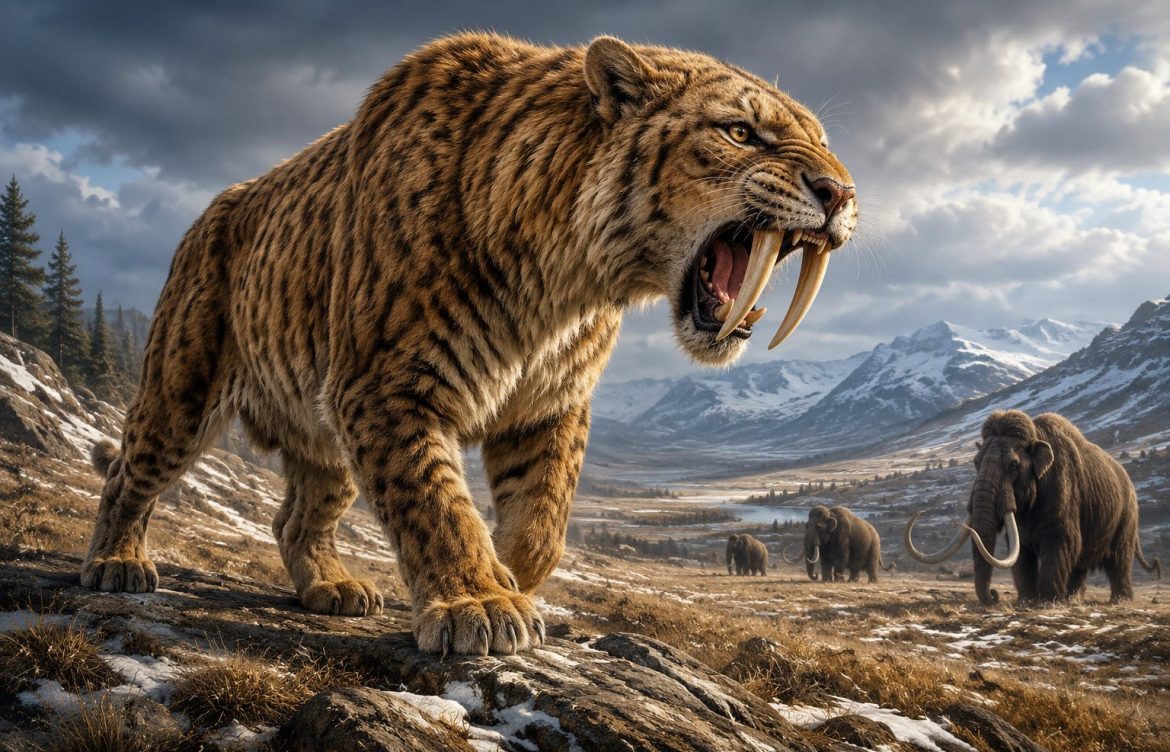
Saber Tooth Tiger: Facts, Size, Extinction, and What We Really Know About Smilodon
Introduction: The Saber Tooth Tiger That Wasn’t Actually a Tiger
The saber tooth tiger is one of those animals that instantly sparks imagination. Most people picture a giant tiger with oversized fangs, stalking prey in a dramatic Ice Age landscape. Hollywood loves this image. Nature, however, tells a slightly different story.
The so-called saber tooth tiger was not a modern tiger at all. The most famous species belonged to the genus Smilodon. Scientists have studied its fossils for over a century, and what we know comes mainly from skeletons, especially the famous saber tooth tiger skull.
In this article, we will break down saber tooth tiger facts, size, habitat, extinction, and even clear up the myth of whether a “real alive saber tooth tiger” still exists today.
Spoiler: it doesn’t—but its story is still very much alive in science.
What Was the Saber Tooth Tiger (Smilodon)?
Despite its name, the saber tooth tiger was not closely related to modern tigers. It belonged to a different branch of prehistoric cats.
The most well-known species, Smilodon, lived during the Pleistocene Epoch, a period that ended around 11,700 years ago.
Scientists classify Smilodon as a “saber-toothed cat,” part of the larger group of prehistoric felines. It was a powerful predator with long canine teeth, built more for strength and ambush than speed.
If modern lions are sprinters with attitude, Smilodon was more like a bodybuilder who preferred surprise attacks.
Saber Tooth Tiger Size: How Big Was It Really?
One of the most searched topics is saber tooth tiger size, and for good reason. People often imagine a massive beast larger than a lion.
Here’s what fossil evidence shows:
- Smilodon fatalis (most common species) was roughly the size of a modern lion
- Body length: around 1.5 to 2.2 meters (excluding tail)
- Weight: approximately 160 to 280 kg depending on the species and sex
- Strong forelimbs, much more muscular than modern big cats
The tail was relatively short compared to modern big cats, which suggests it did not rely heavily on chasing prey over long distances.
Instead, it likely used power, not speed.
So no, it wasn’t a “monster tiger,” but it was still a serious Ice Age heavyweight.
Where Did the Saber Tooth Tiger Live?
If you are wondering where did the saber tooth tiger live, the answer is surprisingly wide.
Smilodon fossils have been found mainly in:
- North America
- South America
- Some regions of the United States (especially California, Florida, and Texas)
- The famous La Brea Tar Pits in Los Angeles
These environments were very different during the Ice Age. Grasslands, forests, and mixed ecosystems supported large herbivores like bison, camels, and prehistoric horses.
Smilodon followed the food. No Uber Eats required.
It likely preferred areas where it could ambush prey from cover rather than chase them across open plains.
Saber Tooth Tiger Skull: The Most Famous Fossil Clue
The saber tooth tiger skull is one of the most recognizable fossils in natural history.
Why? Because it tells us almost everything about how this predator lived.
Key features of the skull:
- Extremely long upper canine teeth (up to 20–28 cm in some species)
- Wide jaw opening (helped it use its long teeth effectively)
- Strong jaw muscles for gripping prey
- Shorter snout compared to modern lions
These teeth were not used for chewing bones like a hyena. Instead, they likely acted like precision weapons to deliver deep, controlled bites to soft tissue.
Think of them less like steak knives and more like specialized daggers.
However, this design also had a downside. Those teeth were fragile. A broken canine could mean serious trouble for survival.
Smilodon Behavior: What Do Saber Tooth Tiger Facts Tell Us?
Let’s talk about saber tooth tiger facts that scientists agree on, based on fossil evidence and modern comparisons.
Here’s what we understand:
- Smilodon was likely an ambush predator
- It used powerful forelimbs to pin prey
- It hunted large animals, not small rodents
- It may have lived in social groups (this is still debated)
- It did not rely on long-distance chasing
Some fossils show healed injuries, which suggests that injured individuals may have survived longer than expected—possibly due to group behavior or scavenging support.
So yes, Smilodon might have had a bit of a “team spirit,” or at least tolerated company when food was available.
When Did the Saber Tooth Tiger Go Extinct?
One of the most important questions is when did the saber tooth tiger go extinct.
Smilodon disappeared at the end of the last Ice Age, roughly 10,000 to 11,000 years ago.
This timing matches the extinction of many large mammals, including mammoths and giant ground sloths.
Scientists believe the extinction was not caused by a single factor, but a combination of:
- Climate change after the Ice Age
- Loss of large prey animals
- Increased competition with other predators
- Human hunting activity (likely indirect but significant)
In simple terms: the world changed faster than Smilodon could adapt.
Nature doesn’t always give second chances.
How Did the Saber Tooth Tiger Go Extinct?
Now let’s answer how did the saber tooth tiger go extinct in a clearer way.
Smilodon depended heavily on large herbivores. When the climate warmed, ecosystems shifted. Forests and grasslands changed, and many prey species declined or migrated.
At the same time, early humans expanded across the Americas. While humans did not directly “hunt Smilodon into extinction” as a single cause, they likely competed for the same prey.
Add in slower reproduction rates and specialized hunting methods, and Smilodon had a difficult survival equation.
In short:
Is There a “Real Alive Saber Tooth Tiger” Today?
Let’s address the internet myth: the idea of a real alive saber tooth tiger.
The answer is simple: no.
No living population of Smilodon or any true saber-toothed tiger exists today.
However, nature still has relatives in a broader sense. Modern big cats like lions, tigers, and jaguars are distant cousins in the cat family tree.
So while you won’t see a Smilodon walking in a zoo or jungle, its evolutionary legacy still lives in today’s predators.
And no, Jurassic Park hasn’t changed this fact yet.
Sabertooth vs Saber Tooth Tiger: Are They the Same?
The term sabertooth is often used casually, but it does not always refer to a single species.
- “Saber tooth tiger” usually refers to Smilodon
- “Sabertooth” can refer to multiple extinct predators with long canine teeth
So while people use both terms interchangeably, scientists prefer “Smilodon” for accuracy.
It’s a bit like calling all smartphones “iPhones”—technically wrong, but emotionally understandable.
Why Was Smilodon So Successful Before Extinction?
Before disappearing, Smilodon was one of the top predators of its time.
Its success came from:
- Strong build for tackling large prey
- Specialized teeth for precise killing bites
- Ability to adapt to different environments
- Likely social cooperation (still debated)
But specialization is a double-edged sword. What makes a species powerful in one environment can make it vulnerable when conditions change.
What We Learn From Saber Tooth Tiger Facts Today
Studying Smilodon is not just about curiosity. It helps scientists understand:
- How climate change affects ecosystems
- How predators adapt or fail to adapt
- How extinction patterns repeat in Earth’s history
Museums like the Smithsonian National Museum of Natural History provide extensive fossil records and research on Ice Age animals, including Smilodon:
https://naturalhistory.si.edu
These fossils are not just bones. They are historical records of survival, adaptation, and extinction.
Conclusion: The Legacy of the Saber Tooth Tiger
The saber tooth tiger remains one of the most fascinating prehistoric predators ever discovered. While it never roared through modern forests, its fossil record continues to teach us valuable lessons about evolution and survival.
From its powerful build to its iconic skull and deadly canines, Smilodon represents both strength and vulnerability in nature.
It ruled its world for thousands of years—but even the strongest predators cannot escape global change.
So the next time you see a dramatic Ice Age documentary, remember: Smilodon wasn’t just a “monster tiger.” It was a highly specialized hunter living in a world that no longer exists.
And maybe that’s what makes it even more interesting.
Sources (Trusted References)
- Smithsonian National Museum of Natural History – https://naturalhistory.si.edu
- California La Brea Tar Pits & Museum – https://tarpits.org
- Encyclopaedia Britannica – Smilodon overview https://www.britannica.com/animal/Smilodon
- University of California Museum of Paleontology – https://ucmp.berkeley.edu