

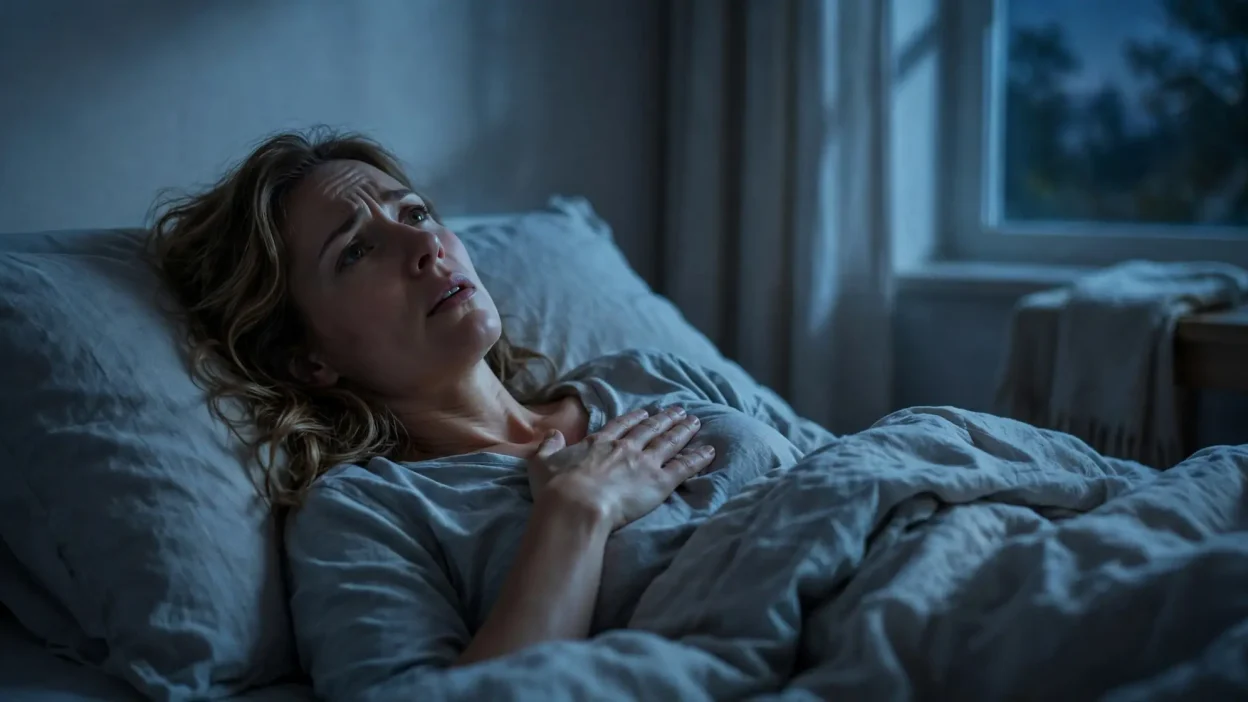
Lying down should be the easiest time to breathe. Your body is at rest, your muscles are relaxed, and you are not asking your lungs to do extra work. So when you lie flat and suddenly feel like you cannot get a full breath, it is frightening — and it is worth paying attention to.
Shortness of breath when lying down has a medical name when it follows a pattern: orthopnea. And when it wakes you up in the middle of the night, gasping, that has another name: paroxysmal nocturnal dyspnea, or PND. Both are patterns doctors take seriously, because the position of your body changes how your heart and lungs work.
This guide explains what shortness of breath when lying down feels like, what usually causes it, when it is an emergency, and what to do next. It is general health information, not a diagnosis. If you are breathless right now and it is severe, get help immediately.
What it feels like
People describe it in different ways, but the pattern is usually the same:
- You feel fine sitting up, but breathless within minutes of lying flat
- You need extra pillows to sleep, or you end up sleeping in a chair
- You wake up 1–2 hours after falling asleep, short of breath, and have to sit up to catch your breath
- You feel a tightness in your chest, or a sense that the air is not going in properly
- The breathlessness eases when you sit up or stand, and comes back when you lie down again
That last point matters. Breathlessness that clearly gets better sitting up and worse lying down points doctors toward specific causes, especially heart-related ones.
Orthopnea: breathlessness when lying flat
Orthopnea is shortness of breath that happens when you lie flat and improves when you sit up or stand. It is one of the classic signs of heart failure, where the heart cannot pump efficiently enough and fluid collects in the lungs.
When you lie down, blood that was pooled in your legs redistributes toward your chest. A healthy heart handles that extra volume easily. A weakened heart cannot, so pressure builds in the lungs and breathing becomes harder. Sitting up reverses the shift, which is why people with orthopnea often sleep propped up on two or three pillows.
Orthopnea is graded by how many pillows a person needs, or whether they have to sleep sitting up. Needing more pillows than you used to, or breathlessness that starts with less and less lying flat, is something to mention to a doctor promptly.
Related reading: What Is Dyspnea? and our full guide to Dyspnea (Shortness of Breath).
Paroxysmal nocturnal dyspnea (PND): waking up gasping
Paroxysmal nocturnal dyspnea is a sudden attack of severe breathlessness that wakes you from sleep, usually one to two hours after you fall asleep. You may feel panicked, need to sit up or get out of bed, and open a window for air. It usually eases after 20–30 minutes sitting up.
PND is closely related to orthopnea and is also strongly associated with heart failure. The delay — an hour or two after lying down — is because fluid slowly shifts into the lungs while you sleep. Like orthopnea, it should prompt a medical evaluation, not a wait-and-see approach.
Read more: What Causes Paroxysmal Nocturnal Dyspnea?
Other causes
Not every case is heart failure. Other common causes include:
Sleep apnea. Breathing repeatedly stops and starts during sleep. You may wake gasping or choking, snore loudly, and feel unrefreshed in the morning. Sleep apnea also strains the heart over time, so it is worth diagnosing.
Asthma and COPD. Airways narrow at night for many people with asthma, and lying flat can make coughing and wheeze worse. COPD can also make it harder to breathe when lying down, especially during a flare-up.
Allergies and reflux. Lying flat lets stomach acid flow back more easily (acid reflux), which can trigger coughing and a feeling of breathlessness. Dust mites and allergens in bedding can do the same for allergy sufferers. See: Can Allergies Cause Shortness of Breath?
Anxiety and panic. Lying in the dark with nothing to distract you can make you notice your breathing more. A panic attack at night can feel like suffocation, even when oxygen levels are normal. The tricky part is that anxiety breathlessness feels identical to a heart or lung problem the first time it happens — so new, unexplained breathlessness should be checked, not assumed to be anxiety.
Obesity, pregnancy and other factors. Extra weight on the chest and abdomen restricts the lungs more when lying down. In later pregnancy, the uterus presses on the diaphragm. Both can cause breathlessness lying flat, and both still deserve a check if the symptom is new or worsening.
When it is an emergency
Call emergency services or go to an emergency room immediately if breathlessness when lying down comes with any of these:
- Chest pain or pressure
- Blue or grey lips, fingertips or face
- Confusion, dizziness or fainting
- Gasping, or breathing that sounds laboured even sitting up
- Swelling in one leg with breathlessness
- Breathlessness that is sudden, severe, or getting worse quickly
Do not wait to see if it passes.
How doctors work out the cause
A doctor will usually start with your history — when it happens, how many pillows you need, whether it wakes you at night, and what other symptoms you have — then a physical exam. Tests may include a chest X-ray, blood tests, an ECG, an echocardiogram (ultrasound of the heart), breathing tests such as spirometry, and sometimes a sleep study.
Doctors also measure breathlessness with scales. The mMRC dyspnea scale grades breathlessness from 0 to 4 based on how much activity triggers it, and the dyspnea visual analog scale records how severe it feels on a 0–10 line. These help track whether treatment is working.
What can help while you wait to be seen
These are coping measures, not treatment for the underlying cause:
- Sleep propped up on extra pillows, or with the head of the bed slightly raised
- Try lying on your side rather than flat on your back
- Keep the bedroom cool and well ventilated, and avoid smoke, strong fragrances and dust
- Practice pursed-lip breathing: breathe in through your nose, then breathe out slowly through pursed lips, as if blowing out a candle
- Avoid large meals and alcohol close to bedtime, which can worsen reflux and sleep apnea
- Keep a note of when it happens, what helps, and any other symptoms — a symptom diary helps your doctor a lot
Do not start, stop or change heart or breathing medication on your own. Treatment depends entirely on the cause, and only a clinician who has examined you can decide it.
When to see a doctor
Book an appointment promptly if:
- Breathlessness lying down is new, or is getting worse
- You need more pillows than you used to, or you have started sleeping in a chair
- It wakes you at night, even once
- It comes with a persistent cough, wheezing, ankle swelling, or unexplained weight change
- You have risk factors such as heart disease, high blood pressure, smoking history, or sleep apnea
FAQs
Is shortness of breath when lying down always heart failure?
No, but heart failure is one of the most important causes doctors rule out first, because it is serious and treatable. Sleep apnea, asthma, reflux, allergies and anxiety can cause the same pattern.
What is the difference between orthopnea and PND?
Orthopnea is breathlessness that starts when you lie flat and eases when you sit up. PND is a sudden attack that wakes you from sleep, usually 1–2 hours after falling asleep, and forces you to sit up to breathe. Both point in the same direction and both need checking.
How many pillows is too many?
There is no fixed number, but needing more pillows than you used to — or sleeping sitting up — is a change worth reporting to a doctor. Doctors sometimes record it as “two-pillow” or “three-pillow” orthopnea.
Can anxiety cause breathlessness when lying down?
Yes, anxiety and panic can cause real breathlessness at night. But because it feels identical to a heart or lung emergency, new breathlessness should be evaluated before it is put down to anxiety.
Should I use a pulse oximeter at home?
It can give useful information, but a normal reading does not rule out a serious problem. It is a data point, not a diagnosis, and it should never replace medical evaluation if you are struggling to breathe.
Conclusion
Shortness of breath when lying down is not a symptom to ignore, especially if it is new, wakes you at night, or keeps getting worse. The pattern — worse flat, better sitting up — is a valuable clue, and doctors use it to narrow down the cause quickly. Most causes are treatable, but only once they are identified. If you are breathless now and it is severe, get emergency help. If it is milder but new, book an appointment and bring a note of when it happens.
Disclaimer: This article is for general information only and is not medical advice. It does not replace evaluation by a qualified healthcare professional. If you are experiencing severe or worsening shortness of breath, seek medical care immediately.


