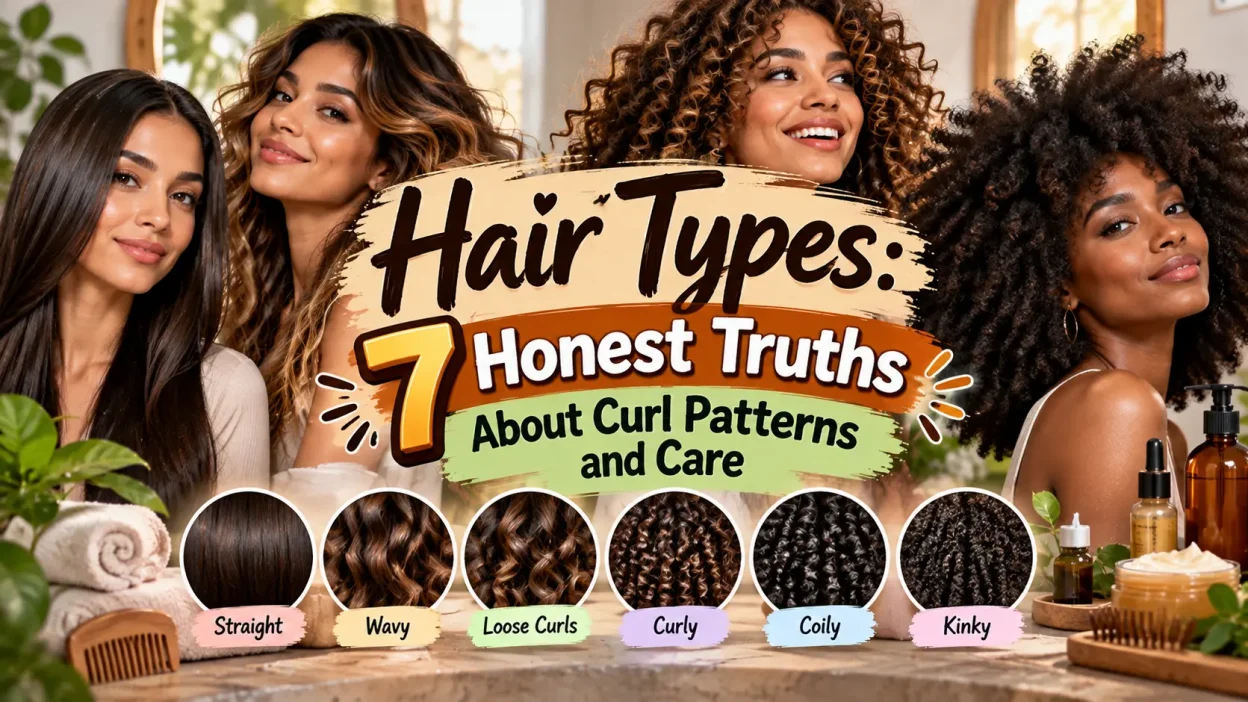
Featuring real science, zero product endorsements, and one very confused curl pattern
Opening: Your Hair Has Been Trying to Tell You Something
Your hair has a personality.
Some hair is straight-laced and predictable — it dries the same way every time, behaves in humidity, and makes you wonder why other people complain so much.
Other hair is dramatic. It curls, it waves, it frizzes, it shrinks up to 75% of its actual length when it dries. It has opinions about the weather. It refuses to be tamed.
And then there’s your hair, which might be a mix of both, depending on which side of your head you’re looking at.
Understanding your hair type isn’t just a vanity exercise. It’s the difference between buying products that work and buying products that sit in your shower for two years because you’re afraid to throw them away. It’s the difference between a hair routine that supports your strands and one that fights against them.
This guide is your friendly, science-backed tour of hair types. We’ll cover the main classification systems, what each type actually means, how to figure out yours, and why some of the labels you’ve seen online are more complicated than they need to be.
No miracle product promises. No “this one trick will change your hair forever” nonsense. Just honest information with a few laughs along the way.
Let’s untangle this.
First Things First: Hair Type vs. Hair Texture (They’re Not the Same)
🎯 The Confusion Is Real
Most people use “hair type” and “hair texture” interchangeably. But they mean different things, and mixing them up can lead to buying the wrong products .
Hair type refers to your curl pattern — the shape your hair takes as it grows out of your scalp. Straight, wavy, curly, or coily. This is the 1-4 system you’ve probably seen .
Hair texture refers to the thickness of individual strands. Fine, medium, or coarse. A single strand of hair, rolled between your fingers, will tell you this .
So you can have “type 2a wavy hair” (curl pattern) that’s also “medium texture” (strand thickness). Two separate things, working together to make your hair uniquely complicated.
😂 Why This Matters
If you have fine, straight hair and you buy a heavy butter-based product designed for coily hair, you’ll end up with limp, greasy strands that look like they haven’t been washed in a week.
If you have coarse, curly hair and you buy a lightweight mist designed for fine hair, your curls will laugh at you and frizz into a halo of defiance.
Knowing both your curl pattern and your strand thickness helps you choose products that actually work .
The André Walker System: The One Everyone Uses (And Criticizes)
🎯 Where It Came From
In the 1990s, Andre Walker — Oprah Winfrey’s hairstylist — created a hair typing system to market his own hair care line. It classified hair into four types: straight, wavy, curly, and kinky, with subcategories A, B, and C for some types .
It was simple. It was visual. It had pictures. And it spread like wildfire.
Today, it’s the most widely recognized hair typing system in the world. When someone says “I have 4C hair,” they’re using Walker’s system.
😂 The Criticism
The Walker system has been criticized for implying a hierarchy — with straight hair at the top and coily hair at the bottom . It’s also been called too simplistic for capturing the full diversity of human hair, especially for mixed-race individuals or people with multiple curl patterns on one head .
But despite its flaws, it’s still the most accessible framework for most people. It gives us a shared language. And that’s valuable.
🌟 Other Systems Exist
A 2026 systematic review identified four mainstream hair classification systems: the André Walker system, the LOIS system, the FIA system, and the L’Oréal Curl Classification System .
The L’Oréal system uses eight categories (I-VIII) and is considered the industry standard for product development . But it’s less familiar to consumers.
For everyday purposes, the Walker system is usually enough. Let’s break it down.
Type 1: Straight Hair — The “Easy” Type That Has Its Own Problems
🎯 The Basics
Type 1 hair is straight. No bends, no waves, no curls. It grows out of your head and goes down. That’s it .
But “straight” doesn’t mean “simple.” There are three subtypes based on strand thickness:
- 1A: Fine, very straight, often lacks volume, tends to get oily quickly
- 1B: Medium thickness, has more body and volume than 1A
- 1C: Coarse, thick, “bone straight,” resistant to curling
😂 The Straight Hair Struggle
People with curly hair often envy straight hair. “It’s so easy,” they say. “You can just wash it and go.”
But straight hair has its own challenges. It can look flat and lifeless. It shows oil faster. It’s hard to hold a curl without industrial-strength hairspray .
The grass is always greener — or in this case, the hair is always straighter on the other head.
🌟 Care Tips for Straight Hair
- Use lightweight products. Heavy creams and butters will weigh it down
- Wash more frequently if your scalp gets oily — daily or every other day is fine
- Condition only the ends, not the roots
- Avoid over-brushing, which can stimulate oil production
Type 2: Wavy Hair — The “Happy Medium” That’s Actually Confusing
🎯 The Basics
Type 2 hair has an “S” wave pattern. It’s not straight, but it’s not fully curly either. It falls somewhere in the middle .
The subtypes:
- 2A: Loose, beachy waves. Fine texture. Waves might not start until a few inches from the roots
- 2B: More defined S-waves. Can be frizzy. Waves are more noticeable
- 2C: Thick, defined waves that start at the root. Almost curly. Very prone to frizz
😂 The Wavy Hair Identity Crisis
Wavy hair is the middle child of hair types. It’s not straight enough to be “easy.” It’s not curly enough to get the “curly girl” support groups.
Wavy hair often gets treated like straight hair by default — brushed, shampooed daily, styled with heavy products — and then it rebels by turning into a frizzy mess .
The key to wavy hair is balance. Too much product and it goes flat. Too little and it frizzes. Too much brushing and the waves disappear. Too little and it tangles .
🌟 Care Tips for Wavy Hair
- Use lightweight moisturizers and curl-enhancing products
- Air dry or use a diffuser on low heat
- Don’t brush dry hair — use a wide-tooth comb in the shower
- Sleep on a satin pillowcase to reduce frizz
Type 3: Curly Hair — The “Most Texturally Diverse” Type
🎯 The Basics
Type 3 hair has defined curls — loops, spirals, corkscrews. It’s bouncy, voluminous, and full of personality .
The subtypes:
- 3A: Loose, large curls. About the width of a quarter. Soft and bouncy
- 3B: Tighter ringlets. About the size of a penny. More defined
- 3C: Tight corkscrews. About the width of a pencil. Dense and voluminous
😂 The Curly Hair Paradox
Curly hair looks coarse but is often actually fine and baby-soft. It looks voluminous but can be surprisingly fragile. It looks like it should be easy to style but requires a whole routine .
The biggest enemies of curly hair? Frizz and shrinkage. Humidity makes it frizz. Drying makes it shrink. It’s a constant battle.
And here’s the thing: curly hair is naturally drier than straight hair because the oils from your scalp have a harder time traveling down the twists and turns of the strand . So it needs more moisture, more often.
🌟 Care Tips for Curly Hair
- Moisture is everything. Use leave-in conditioners and curl creams
- Apply products to soaking wet hair to lock in hydration
- Don’t towel-dry aggressively — use a microfiber towel or t-shirt
- Comb in the shower, not after
- Avoid sulfates and harsh cleansers
Type 4: Coily Hair — The “Most Delicate” Type
🎯 The Basics
Type 4 hair is tightly coiled, with a zig-zag or spiral pattern. It’s often called “kinky” or “Afro-textured” hair .
The subtypes:
- 4A: Tight, defined S-shaped coils. Springy and soft
- 4B: Z-shaped coils with less definition. Very fragile
- 4C: Extremely tight, densely packed coils. Shrinks up to 75% of its actual length. The most delicate type
😂 The Shrinkage Reality
If you have 4C hair and you pull a strand straight, you might be shocked by how long it actually is. Your hair might be shoulder-length when stretched but look like a tiny halo when dry .
This is shrinkage, and it’s completely normal. It happens because the coils contract as they dry, pulling the hair up toward the scalp.
Shrinkage isn’t damage. It’s just your hair doing its thing.
🌟 Care Tips for Coily Hair
- Moisture is non-negotiable. Use rich creams, butters, and oils
- Handle gently. This hair is fragile and prone to breakage
- Detangle with fingers or a wide-tooth comb, never a fine-tooth brush
- Protective styles (braids, twists, bantu knots) help retain length
- Deep condition regularly
The Science: Why Curly Hair Curls (And Why It Matters)
🎯 The Shape of Things
Straight hair has a round cross-section. Curly hair has an elliptical (oval) cross-section. The more elliptical the shape, the tighter the curl .
This isn’t just trivia. It affects everything from how light reflects off your hair (curly hair is less shiny because the surface is less smooth) to how fragile it is (curly hair has more weak points where cracks can form) .
😂 The Follicle Shape Connection
The shape of your hair follicle — the little pocket in your scalp where hair grows — determines the shape of your hair. A round follicle produces round, straight hair. An asymmetrical follicle produces elliptical, curly hair .
You can’t change your follicle shape. You can only work with it.
🌟 What This Means for Care
Curly and coily hair is naturally drier because the oils from your scalp can’t easily travel down the twists and turns. This is why moisture is so critical for types 3 and 4 .
It’s also why curly hair is more prone to breakage — the uneven surface creates weak points .
Understanding the science helps you stop fighting your hair and start supporting it.
Hair Density and Porosity: The Other Things That Matter
🎯 Density: How Much Hair You Have
Hair density is the number of strands on your head. The average person has between 80,000 and 120,000 strands .
You can estimate your density by measuring your ponytail circumference:
- Less than 2 inches: low density
- 2-3 inches: medium density
- 4 inches or more: high density
😂 Porosity: How Your Hair Absorbs Moisture
Porosity is how easily your hair absorbs and retains water .
Low porosity hair has tightly closed cuticles. It takes forever to get wet and products tend to sit on top rather than absorbing.
High porosity hair has raised cuticles. It gets wet quickly but loses moisture just as fast. It’s often damaged or naturally porous .
🌟 Why These Matter
Two people with the same curl type can need completely different products based on density and porosity.
High-density, low-porosity hair might need lightweight products to avoid buildup. Low-density, high-porosity hair might need rich moisturizers to seal in hydration .
Your curl type is just the starting point. Density and porosity fill in the rest of the picture.
Tips Section: How to Use This Information Effectively
🎯 Find Your Type
Wash your hair, apply no products, and let it air-dry completely. Then look at it. That’s your natural curl pattern .
Take a single strand and roll it between your fingers. Can you feel it? If barely, it’s fine. If clearly, it’s coarse. If somewhere in between, it’s medium .
😂 Choose Products Wisely
Once you know your type, texture, density, and porosity, you can make informed choices.
- Fine, straight hair: Lightweight, volumizing products
- Coarse, curly hair: Rich, moisturizing products
- Low porosity: Lightweight products, avoid heavy oils that sit on top
- High porosity: Rich moisturizers to fill the gaps in the cuticle
🌟 Wash According to Your Needs
The old rule “wash every day” doesn’t work for everyone.
If you have straight, oily hair, daily washing might be fine .
If you have curly, dry hair, washing every 2-3 weeks might be enough. Between washes, use a co-wash (conditioner washing) to refresh your scalp without stripping your hair .
😂 Be Gentle
Hair is most fragile when wet. Use a wide-tooth comb. Start from the ends and work upward. Don’t rip through tangles .
🌟 Embrace Your Pattern
The best hair routine is one that works with your natural texture, not against it.
If your hair is curly, let it curl. If it’s coily, let it coil. If it’s straight, let it be straight. Fighting your natural pattern is a losing battle.
11. FAQ: Your Hair Type Questions, Answered
Q1: What is a hair type?
Hair type refers to your natural curl pattern — straight, wavy, curly, or coily. It’s usually described using the André Walker system, which uses numbers 1-4 with subcategories A, B, and C. Hair type is different from hair texture, which refers to the thickness of individual strands .
Q2: Why do people care about hair types?
Because different hair types have different needs. Curly and coily hair is naturally drier and more fragile than straight hair. Knowing your type helps you choose products that actually work, avoid damage, and style your hair without fighting its natural pattern .
Q3: How do I find my hair type?
Wash your hair, apply no products, and let it air-dry. Then observe the pattern. Use a strand of hair to assess thickness (fine, medium, or coarse). For a more complete picture, also consider your hair’s density (how much hair you have) and porosity (how well it absorbs moisture) .